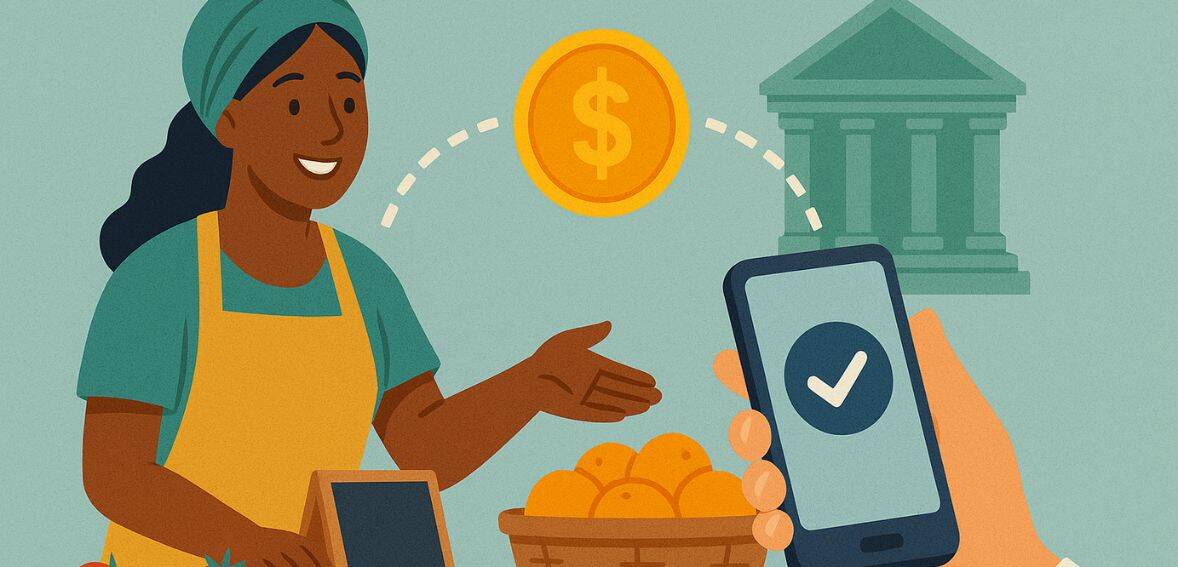
It has always been the case that local economies are highly dependent on vendors in various markets. From fresh produce stalls, handmade crafts, street food carts, to neighbourhood service booths, these micro-entrepreneurs are quite crucial to community life. Yet despite this importance, they tend to largely elude conventional funding.
Banks generally require documentation that few vendors have: business registration papers, extensive credit histories, audited financials, or collateral. For many vendors, these requirements create an unseen barrier that prevents them from getting even the modest loans needed to develop.
The development of digital payments quietly transformed this reality. What had been an informal, unrecorded company suddenly becomes visible and measurable once transactions are registered electronically. This transparency is becoming a turning point for micro-vendors in search of finance.
Today, digital payments don’t just help vendors better service the consumer; they may hold the key that unlocks micro-funding, grants, and small-business finance previously unreachable. This paper explores exactly how digital payments change the trustworthiness of vendors, how lenders apply transaction data to grant funding, and how market sellers may strategically install payment systems to qualify themselves for life-changing financial opportunities.
The Hidden Funding Gap for Market Vendors

There has always been a financial shortfall for micro-vendors. They consistently make money, but they do not have the papers and records to prove this. Traditional banks apply formal lending criteria based on organizations with digitized financial trails, registered businesses, or salaried staff.
Even if the fruit vendor or food stand owner generates enough cash to feed a family and reinvests that money into inventory, institutions that rely on official documentation cannot see that business. Without the necessary documentation, the vendors resort to cash-based borrowing from unauthorized lenders who frequently charge usurious interest rates.
The result of this is that vendors end up paying more on debt than on expansion. Many could expand, but they simply lack access to appropriate finance. Digital payments have started to bridge this divide. Every transaction becomes a proof point.
Every sale that gets recorded becomes a part of the vendor’s financial identity. The gradual traceability of the informal economy makes it possible to have micro-funding platforms that explicitly assess digital transaction histories. This momentous shift democratizes the availability of capital without dragging vendors into unnecessary paperwork or processes that do not correspond with their realities.
Why Digital Payments Are a Game Changer
More than a technological advancement, shifting from cash to digital payments fundamentally changes how people view a business. Cash transactions disappear the minute they occur, leaving no apparent trace for lenders. Suddenly, with digital payments, merchants have a quantifiable financial footprint.
With this, lenders can analyze trends, predict sales, observe seasonality, and gauge the ability of a vendor to repay, even in the absence of any conventional paperwork. Digital payments allow for transparency without the need for formal recordkeeping. When the vendor makes payments using mobile wallets, QR codes, or point-of-sale systems, automated records are created.
These documents are impartial, time-stamped, and difficult to forge. That reduces risk for lenders and increases confidence for funding platforms. Vendors become eligible to receive microloans, not because they have collateral, but because they have regular transaction data. In time, this brings visibility to relationships.
Payment platforms themselves start offering integrated credit, since they already have access to the vendor’s whole transaction history. Digital wallets interact with micro-finance institutions in order to offer rapid microloans based on the success of weekly sales.
Processes that would have traditionally required paperwork and drawn-out approvals can now be conducted in a matter of minutes because the vendor’s company is visible. Choosing the right payment tools also matters, and learning about the different types of POS systems can help vendors select options that best support their daily operations.
Digital Transaction Histories as a New Kind of Credit Score
Although micro-vendors infrequently have traditional credit ratings, their regular financial behaviour can predict trustworthiness more precisely than official credit reports. Digital payments help translate such behaviour into measurable analytics. A vendor’s number of daily sales, normal transaction values, peak hours, recurring customers, refund patterns, and cash-out behaviour all give a realistic picture of their business stability.
Lenders appreciate this openness. Instead of depending on assumptions, they can examine if a vendor’s income is seasonal, whether it exhibits upward growth, or whether it swings in predictable cycles. Even tiny patterns—such as low return rates or consistent weekly sales—become important signs of dependability.
Digital micro-funding systems assess current company operations in the same manner that traditional credit systems examine loan histories. A merchant that consistently receives digital payments creates a pattern that resembles a “digital performance score.” Because it is based on everyday behaviour rather than out-of-date financial snapshots, this score eventually becomes just as relevant as a traditional credit score, often even more so.
How Payment Platforms Use Data to Approve Micro Funding

Most current digital payment solutions don’t merely process transactions—they analyze them. Fintech businesses have developed advanced algorithms that use transaction patterns to safely identify risk levels.
For example, a digital wallet may offer a seller a limited credit line depending on their last ninety days of income. If a user’s daily transactions surpass an established level, a QR-code payment app may offer a weekly credit boost. Instant approvals are made possible by embedded lending agreements, which use real-time cash flow analysis and prediction algorithms.
These payment-driven loans eliminate the need for traditional documentation. The program already knows how much a merchant earns, so repayment plans are typically automatically deducted from future sales. This reduces stress for the vendor, who doesn’t have to remember due dates or navigate banking systems.
It also reduces risk for lenders, who recover loans gradually based on actual performance. This fluid loan strategy allows merchants to borrow smaller sums more regularly, enabling them to buy products, upgrade equipment, or expand their stall without taking on significant long-term debt. Micro financing becomes realistic, adaptable, and matched with real financial behaviour rather than strict standards.
Why Lenders Trust Digital Payment Data More Than Cash Records
Because cash transactions cannot be verified, lenders have always been wary of market vendors, not because they make too little money. Anyone can claim a particular daily income, but without evidence, it’s hard to evaluate risk. This credibility issue is resolved with digital payment data.
Verifiable proof of income is provided by every electronic transaction. Lenders can track sales without reliance on self-reported estimates. Digital payments also decrease the possibilities of falsifying numbers or misrepresenting financials. Vendors who accept digital payments exhibit discipline, transparency, and a commitment to operate honestly.
Moreover, digital payment histories offer lenders consistent insights into repayment possibilities. Lenders are optimistic that repayments can be collected through automated deductions if a vendor generates daily digital revenue. Because of this predictability, default rates are lowered and more institutions, both public and private, are encouraged to provide microfinance programs tailored to digital-first providers.
The Role of Mobile Wallets and QR Payments in Vendor Growth

Mobile wallets and QR payments have become the entrance point for most market merchants moving to digital systems. They require no hardware expenditure and are accessible from even the simplest cellphones.
For vendors without actual stores—street food sellers, travelling merchants, or door-to-door service providers—QR payments offer flexibility and quick legitimacy. Additionally, QR codes let companies adapt to current consumer behaviours. More clients want to pay digitally, especially in metropolitan areas where carrying cash is becoming less frequent.
Vendors gather more transaction data as digital payments rise, and better data enhances microfunding eligibility. Mobile wallets also allow instant settlements, so merchants don’t have to wait days for payments to reach their accounts.
This helps them manage daily inventory purchases and operational expenses smoothly—an essential factor for small vendors who cannot afford any delays. Vendors looking to modernize their payment process can benefit from a simple POS system setup to streamline sales and improve transaction tracking.
Building Financial Identity Through Digital Tools
In the past, formal businesses were the only ones with a financial identity. Digital payments now allow even the smallest vendors to build one. Each transaction, reimbursement, or payment is incorporated into a digital trail that enhances the vendor’s reputation within the financial system.
This identity goes beyond income proof. It builds trust. It demonstrates behaviour. It shows lenders how serious the vendor is about running a stable business. With time, this identity turns into an asset that allows vendors to obtain advanced financial products like insurance, payment advances, savings plans, and business tools in addition to microfunding.
The power of digital payments lies in transforming an invisible entrepreneurial community into one that financial institutions cannot overlook. For the first time, street vendors and market traders have a way to prove their worth without relying on outdated or rigid systems.
Expanding Eligibility Through Payment History Consistency
Qualifying for funding is not only about the amount a vendor earns—it’s about regularity. Micro lenders investigate patterns such as daily sales stability, weekly income cycles, and seasonal swings. Stronger eligibility profiles are regularly developed by vendors who take digital payments.
For example, a merchant who performs fifty digital transactions each day demonstrates regular income trends. Even if their total revenue isn’t high, lenders trust the regularity more than occasional jumps. However, eligibility growth may be slower for sellers who accept both cash and digital payments.
Consistency in payment methods is vital since it ensures the data is reliable. Digital payment records make it evident that many funding programs favor vendors who have fewer returns and disputes. In this way, digital payments encourage vendors to maintain high service standards, because better service leads to better eligibility for financial support.
Digital payments reduce risk for both sides

For vendors, high interest rates and personal risk go hand in hand with informal lenders. On the flip side, for lenders, giving loans out to undocumented cash-only vendors involves its own risks. Digital payments eliminate uncertainty both ways.
Vendors reduce risk because:
- They no longer rely on predatory lenders.
- Repayments are automated instead of being stressful.
- They can borrow smaller amounts when required instead of taking large sums.
- Digital records of transactions protect the transactions from disputes or misunderstandings.
Lenders reduce risk because:
- They analyze real financial behavior rather than assumptions.
- They get reliable mechanisms of repayment through automated deductions.
- Vendors who have strong digital payment trails are statistically more responsible.
- The risks for fraud lessen when each transaction is traceable.
This mutual decrease of risk is what has accelerated the rise of digital payment-driven micro funding across markets worldwide.
Access to Government and NGO Microfunding Programs
Digital payments are increasingly understood by governments and NGOs alike as the critical bridge to supporting underserved vendors. Most microfunding programs require, or at least prefer, a digital transaction history when going through a qualification process. This allows for the identification of real vendors and reduces the misuse of funds by targeting support to those who need it most.
Digital payments are, in fact, proof that a vendor is active, consistent, and engages with customers. This is far more reliable for funding agencies than traditional documents. More grants, zero-interest loans, and enterprise-support programs are opening their doors to vendors who can show them digital revenue streams.
The more digital a vendor goes, the more they open themselves to everything from seed funding to women-entrepreneur grants to market-stall support schemes. Digital inclusion is not just a trending topic, but an increasingly important prerequisite for long-term financial success.
Why Cash-Only Vendors Lose Opportunities
Cash-only enterprises remain invisible to most modern funding institutions. In the absence of digital records, vendors have to depend on self-reported income statements, which no lender will accept. Cash-only operations also can’t prove revenue stability, and must comply with responsible lending according to micro-funding programs.
Customers increasingly prefer digital payment options, so vendors sticking to cash may lose sales. They also lose access to digital tools that streamline operations, such as automated bookkeeping, expense tracking, and integrated savings features. Finally, cash-only systems expose vendors to risks like theft, disputes, counterfeit currency, and loss during transportation.
Vendors, by refusing digital modes of payment, are unknowingly shrinking their potential growth and reducing their qualification chances for micro-funding, which could help them grow.
Digital Payments: A Path to Scaling Operations
So many market vendors dream of expanding—adding a new stall, investing in better equipment, selling in bulk, or bringing in an assistant. Micro-funding makes that possible, but only if lenders can trust the vendor’s ability to repay. Digital payments provide that proof.
Once vendors secure microloans, they can purchase inventory in larger quantities, reducing the cost per unit. They can invest in branding or customer experience upgrades. They can diversify their product offerings. Most importantly, they gain confidence to operate as business owners rather than survival-driven workers.
Growth is possible when financial power combines with operational visibility. Digital payment methods act as the bridge that will connect small vendors to their future potential from the present.
Reducing Operational Stress with Digital Tools

Managing a cash-based business is perpetually stressful: counting money, storing it, giving change, preventing theft, and keeping mental books. Digital payments take much of the mental overhead away from them. Vendors can track sales automatically, monitor daily revenue, and plan inventory with greater accuracy.
This, in turn, reduces stress levels and improves customer service, adding to personal well-being. A less overwhelmed vendor is more likely to manage finances responsibly, further strengthening eligibility for micro-funding. Digital tools also help vendors separate personal and business finances, reducing confusion and avoiding the accidental misuse of business revenue.
The shift to digital payments is not just financial; it’s a quality-of-life changer for the vendors in the marketplace, helping them have clarity and direction in their operations.
The Bigger Picture: Digital Payments as an Economic Equalizer
Digital payments do more than help individual vendors; they help entire economies. When millions of micro-entrepreneurs become visible, governments gain clearer economic data, communities gain stronger marketplaces, and lenders can expand micro-funding safely, all in a self-reinforcing ripple as local economies grow from the ground up.
Digital transformation levels the playing field. It brings the smallest vendors into the financial system. It bridges inequality. It creates opportunities where barriers once existed. And it builds resilient communities where entrepreneurship thrives regardless of background or paperwork. It’s not a technological transformation, but about access, dignity, and possibility.
Conclusion
More than a modern convenience, digital payments are a lifeline to growth for market vendors. Turning everyday transactions into financial proof, digital tools open the door to micro-funding that was previously inaccessible. What once required paperwork, collateral, and credit history can now be achieved through simple QR codes, wallet transactions, and consistent digital sales patterns.
Around the world, digital payments are about empowerment for vendors. They help build financial identity and strengthen trust in operations, opening up opportunities that truly enable business growth. Micro-funding becomes possible, repayments become affordable, and growth is sustained.
The journey from informal vendor to empowered entrepreneur begins with one simple decision: accepting digital payments and allowing the business to become visible. When visibility leads to credibility, and credibility leads to opportunity, digital payments become more than a tool-they become the gateway to a better future.