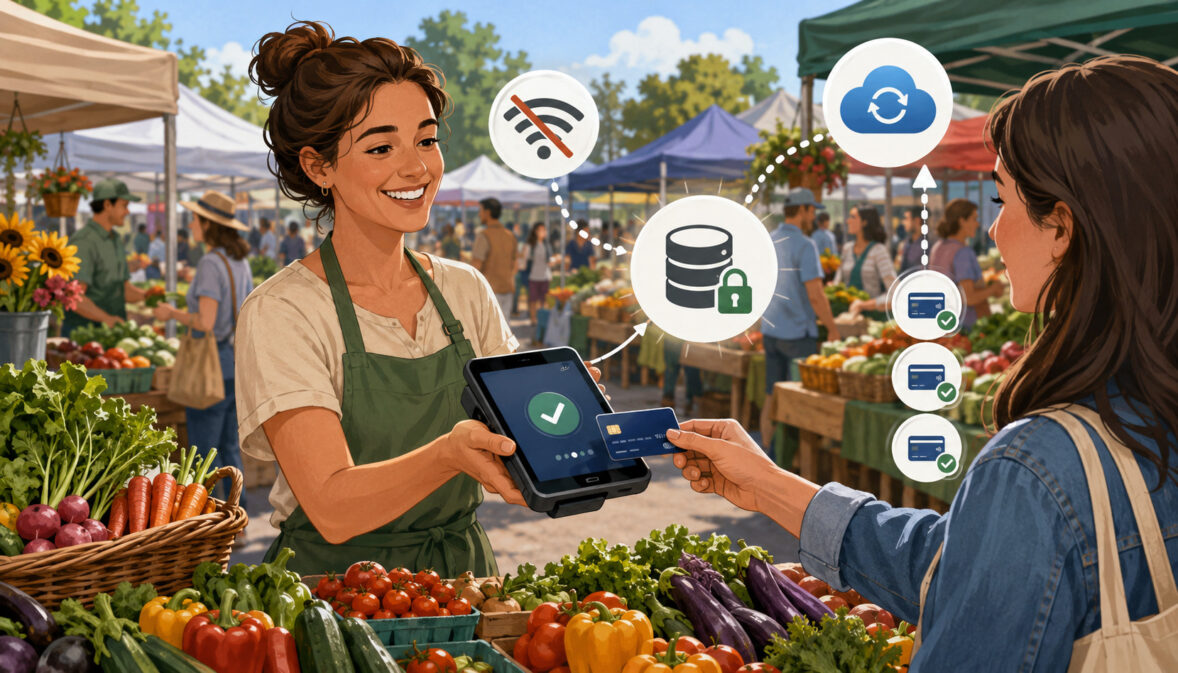
Farmers markets bring together fresh produce, baked goods, flowers, meats, dairy products, prepared foods, pantry items, handmade crafts, and seasonal products in a temporary outdoor setting. Although the atmosphere may feel simple and traditional, customers increasingly expect vendors to accept cards, contactless payments, and digital wallets alongside cash.
That expectation can create a challenge. Many markets operate in rural locations, parking lots, parks, fairgrounds, historic districts, or crowded downtown areas where cellular service and public Wi-Fi may be unreliable.
Even when a strong signal is available early in the morning, network congestion can slow payment authorization as shoppers arrive and dozens of vendors begin using the same cellular towers.
Offline credit card processing at farmers markets gives eligible vendors a way to continue recording card sales when their device temporarily loses internet access.
Instead of sending every payment for immediate authorization, an offline-capable farmers market POS system securely stores transaction information and uploads it after connectivity returns.
This can keep checkout lines moving and reduce the number of customers who leave because they do not have enough cash. However, offline card payments are not the same as guaranteed payments.
Because some transactions may not be authorized until later, vendors must consider delayed declines, fraud exposure, duplicate transactions, syncing procedures, transaction limits, receipts, device security, and reconciliation.
A dependable setup combines suitable payment technology with sensible operating procedures. Vendors should understand how offline payment mode works, test it before market day, train anyone handling checkout, protect payment devices, and reconnect as soon as practical.
What Is Offline Credit Card Processing at Farmers Markets?
Offline credit card processing is a feature that allows a compatible payment application or terminal to record card transactions when an internet or cellular connection is unavailable. The transaction is held securely on the approved device and submitted after the system reconnects.
In a normal online transaction, the terminal sends payment information through the payment network to request authorization from the card issuer. The response usually arrives within seconds, telling the vendor whether the transaction was approved or declined.
Offline processing changes that sequence. The vendor records the purchase first, but authorization may be delayed until the stored transaction is uploaded.
Depending on the POS system, card type, terminal configuration, processor rules, and transaction settings, certain checks may happen locally while other checks cannot occur until connectivity returns.
For farmers market vendors, offline payment mode may be helpful during temporary service interruptions. A produce seller might lose cellular coverage for five minutes during the morning rush, while a craft vendor at a rural market might experience weak coverage throughout the event.
Not every mobile POS, card reader, payment terminal, card type, or transaction qualifies for offline processing. Some systems support offline sales only through specific hardware. Others impose time limits, ticket-size limits, cumulative dollar limits, or restrictions on contactless, manually entered, debit, or international cards.
Before relying on offline payments for farmers markets, vendors should review the exact operating rules provided for their account. A system displaying an “offline” symbol does not necessarily mean that every payment method will work without connectivity.
How Offline Payment Mode Works
The basic process begins when the POS application or terminal recognizes that it cannot connect to the payment service. If offline mode is enabled and the transaction qualifies, the system allows the vendor to continue with the sale.
The vendor enters the products, quantities, taxes, tips, discounts, and final total. The customer then presents an eligible card using the supported card reader. The device captures the transaction through the method permitted by the system, which may include an EMV chip card, tap-to-pay transaction, or another supported card-entry method.
The payment application stores the transaction in an encrypted or otherwise protected form. The vendor may be able to issue a printed receipt immediately, while an emailed or SMS receipt may be held until connectivity returns.
When the phone, tablet, or terminal reconnects, the application submits the stored transactions. The system then attempts payment authorization and places approved transactions into the normal settlement process.
A typical offline payment flow includes:
- Entering the customer’s order in the POS.
- Confirming the total, taxes, discounts, and tips.
- Accepting the card through an approved reader.
- Recording the transaction in offline mode.
- Providing an available receipt.
- Keeping the device powered and protected.
- Reconnecting to Wi-Fi or cellular service.
- Uploading or syncing stored transactions.
- Reviewing approvals, declines, duplicates, and errors.
- Reconciling the final sales report.
The exact sequence varies between payment systems. Vendors should follow the instructions associated with their own equipment rather than assuming all offline POS payments behave the same way.
Offline Processing vs Online Processing
Online card processing requests authorization while the customer is still at the booth. The card issuer can check factors such as the account status, available funds or credit, expiration information, fraud controls, and other authorization rules before returning a response.
An approved online transaction gives the vendor more immediate confidence that the payment has passed the authorization stage. It does not eliminate all risk because transactions may still be disputed, reversed, refunded, or affected by other account conditions.
Offline processing records the sale without completing the same real-time communication. The customer can leave with the goods before the issuer has returned an approval or decline.
This difference is important for perishable products and one-time market sales. A vendor cannot easily recover a basket of produce, custom food order, handmade item, or bulk meat purchase after the customer has left the market.
Offline processing can improve continuity, but it increases uncertainty. Vendors generally need stricter controls for offline ticket amounts, employee permissions, unusual purchases, repeated attempts, and delayed syncing.
Online processing should normally remain the preferred method whenever stable connectivity is available. Offline payment mode works best as part of a broader continuity plan that may also include cash, a mobile hotspot, another network connection, payment links, and invoices for suitable orders.
Why Farmers Market Vendors Need Offline Payment Options
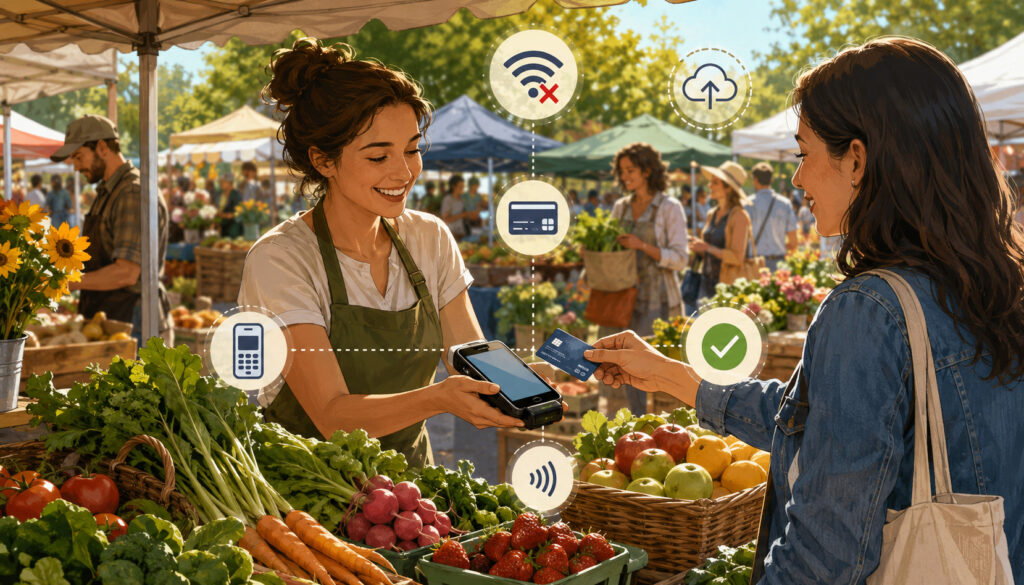
Farmers market payment processing takes place in environments that were not necessarily designed for dependable electronic checkout. Vendors often operate under tents with battery-powered devices, folding tables, portable displays, coolers, generators, and limited access to permanent internet service.
A market may advertise public Wi-Fi, but that network may slow significantly once vendors, shoppers, event staff, and nearby businesses connect. Public networks can also have login pages, timeouts, security restrictions, or signal gaps between different sections of the market.
Cellular service is not always more reliable. Rural areas may have limited tower coverage, while crowded urban events may overload available capacity. Weather, nearby buildings, trees, temporary structures, and the placement of a vendor’s booth can also affect signal strength.
Without a backup, a temporary outage may force a vendor to accept only cash. That can frustrate shoppers who planned to use a credit card, debit card, phone, or wearable device.
A properly configured offline payment option can help vendors continue operating during short disruptions. It may be especially useful for businesses selling higher-priced baskets, meat packages, specialty foods, crafts, flowers, prepared meals, or multiple-item orders that customers may not have enough cash to cover.
Vendors researching a suitable mobile POS for farmers markets should review offline capability separately from general mobile payment support. A system that works well over cellular service may not necessarily store transactions when service disappears.
Connectivity Challenges at Outdoor Markets
Outdoor markets can produce unpredictable network conditions. A vendor may complete several online transactions successfully and then suddenly lose connectivity when shopper traffic increases.
Shared Wi-Fi presents another concern. The available bandwidth may be divided among many users, resulting in timeouts or long authorization delays. A network may appear connected on the device even though it cannot reliably reach the payment service.
Cellular performance can also differ by carrier. One vendor may have strong service while the booth next door has almost none because their devices use different networks.
Common connectivity problems include:
- Weak rural cellular coverage.
- Congestion during peak market hours.
- Public Wi-Fi login interruptions.
- Unstable hotspot connections.
- Signal obstruction from buildings or tents.
- Weather-related service interruptions.
- Battery-saving settings that disable connections.
- Bluetooth disconnection between the reader and mobile device.
- Software updates that interfere with the POS app.
- Limited data plans or exhausted hotspot allowances.
Vendors should test connectivity from their actual booth location whenever possible. Testing from the parking area or market entrance may not reveal dead zones inside the selling area.
It is also useful to check the connection at the same time of day that the market will operate. Network conditions at 6:00 a.m. may be very different from conditions during the busiest shopping period.
Keeping Checkout Moving During Busy Market Hours
A network interruption can quickly create a long line. Staff may repeatedly tap buttons, restart readers, move devices around the booth, or ask customers to wait while the terminal reconnects.
These delays affect more than one transaction. Shoppers waiting behind the affected customer may abandon their purchases, choose a nearby vendor, or reduce the size of their order.
Offline POS payments can provide a smoother fallback when staff understand the process. Instead of repeatedly attempting an online authorization, the vendor can follow the system’s approved offline steps, issue a receipt where possible, and move to the next customer.
The value is particularly noticeable during short, high-volume market periods. Many vendors earn a large share of their daily sales within a few busy hours. Losing card acceptance for even a brief period can disrupt sales and create inventory problems.
Speed should not override risk controls, however. Employees should not accept every large or unusual offline order simply to shorten the line. A rushed transaction can create greater losses than a slower checkout.
A balanced procedure might allow ordinary low-value purchases in offline mode while requiring cash, a payment link, a mobile hotspot connection, or online authorization for unusually large orders.
Clear signage can also help. A small notice stating that cash and cards are accepted, subject to connectivity, prepares customers without drawing unnecessary attention to technical problems.
How Farmers Market Credit Card Processing Works Offline

Farmers market credit card processing usually involves a mobile application, a connected card reader, and a merchant account or payment service. When the system is online, transaction information is transmitted immediately for authorization. When supported offline mode is active, the transaction is temporarily stored instead.
The technical details vary significantly. Some platforms require the vendor to enable offline mode in advance. Others switch automatically when connectivity fails. Certain terminals can operate independently, while mobile readers depend on a Bluetooth connection to a phone or tablet even when internet access is unavailable.
The device may store the transaction until it reconnects, but storage duration is not unlimited. A payment provider may require transactions to be submitted within a specific period. Transactions left unsynced beyond that period may be rejected or become ineligible for processing.
After uploading, approved transactions may be included in the next available batch or settlement cycle. Funding timing can depend on when the transactions sync, when the batch closes, weekends, holidays, account review, and processor policies.
Vendors should also understand how sales reporting behaves. Some systems show offline sales in the daily total immediately but mark them as pending. Others separate them from approved card sales until syncing is complete.
The most important operating principle is that “recorded” does not always mean “approved.” Staff should know the visual difference between an offline transaction, a pending transaction, an approved transaction, and a failed upload.
Step-by-Step Offline Payment Flow
A well-organized offline checkout begins before the customer presents a card. Products, prices, tax settings, discounts, and inventory should already be configured so staff can enter the sale accurately.
First, the cashier adds items or enters the total. Before requesting payment, the cashier confirms the amount with the customer.
Next, the POS indicates that it is offline or unable to connect. The cashier verifies that approved offline payment mode is active rather than assuming a frozen application has recorded the sale.
The customer inserts, taps, or presents the card through the method supported by the terminal. The cashier waits for the system to confirm that the offline transaction has been stored.
The vendor should avoid repeatedly running the same card unless the application clearly states that the first attempt failed. Repeating a transaction because the screen responds slowly can create duplicate charges after synchronization.
The cashier then offers an available receipt and completes the sale. If digital receipt delivery requires internet access, the vendor should explain that delivery may occur after the transaction syncs.
After service returns, the vendor opens the POS, confirms that syncing has started, and keeps the application connected until all stored transactions have uploaded. The final step is reviewing the transaction report for declines, duplicates, partial uploads, or unresolved errors.
What Happens When the Device Reconnects
When connectivity returns, the POS application begins sending stored transactions to the payment service. Some systems do this automatically in the background, while others require the vendor to open the application, remain signed in, or select a sync option.
Each transaction then moves through the required authorization process. Some will be approved and included in settlement. Others may be declined because of insufficient funds, an expired card, a closed account, suspected fraud, card restrictions, or other issuer decisions.
The vendor should not assume that all offline transactions uploaded successfully simply because the device is online. A complete review should confirm:
- How many offline transactions were stored.
- How many were uploaded.
- How many were approved.
- Whether any were declined.
- Whether any duplicates appeared.
- Whether receipts were delivered.
- Whether sales and inventory reports updated.
- Whether approved transactions entered settlement.
- Whether any transactions require follow-up.
If a payment is declined after the customer has left, recovery may be difficult. A vendor may have customer contact information for a special order, invoice, or delivery, but ordinary market transactions are often anonymous.
This is why transaction limits and prompt syncing matter. The longer transactions remain stored, the longer the vendor operates without knowing whether the payments will be approved.
Whenever possible, vendors should sync during a quiet period, immediately after service returns, or directly after the market rather than waiting several days.
Offline Credit Card Processing Compared With Other Payment Options
No payment method is ideal for every booth, product, and market. A produce stand handling frequent low-value sales may have different needs from a vendor taking deposits for custom furniture, bulk meat packages, catering orders, or seasonal subscriptions.
Offline card processing provides continuity, but it does not eliminate authorization risk. Online card processing offers immediate authorization but depends on connectivity. Cash works without power or internet but requires secure handling and sufficient change.
Contactless payments at farmers markets can create a fast customer experience when the reader and network support them. Payment links and invoices may be useful for custom orders, preorders, deliveries, and wholesale purchases, but they depend on customer follow-through.
The following table compares common farmers market payment solutions.
| Payment Method | Best For | Benefits | What to Review |
| Offline card processing | Temporary outages and weak-signal areas | Keeps eligible card sales moving | Delayed declines, transaction limits, and sync timing |
| Online card processing | Locations with strong internet or cellular service | Provides real-time authorization | Wi-Fi, cellular reliability, and device connection |
| Cash payments | Simple and low-ticket sales | Requires no internet or payment device | Change, counting procedures, security, and deposits |
| Mobile wallets | Fast contactless checkout | Convenient for customers using phones or wearables | Reader compatibility, offline eligibility, and signal support |
| Payment links | Follow-up or remote payments | Useful for preorders and post-market purchases | Customer completion, expiration, and recordkeeping |
| Manual invoices | Custom, bulk, or business orders | Supports detailed billing and later collection | Payment terms, customer records, and collection procedures |
| Mobile hotspot | Restoring online authorization | Provides a backup connection | Carrier coverage, battery, data allowance, and security |
A vendor’s final payment mix should reflect average ticket size, customer preferences, product type, staffing, booth layout, and the risk the business can reasonably manage.
How to Choose the Right Payment Mix
Begin by reviewing how customers currently pay. If most purchases are small and many shoppers carry cash, a cash drawer and online mobile POS may be sufficient, with offline mode used only during brief outages.
Vendors with larger average orders may need more connectivity backups because the potential loss from a declined offline transaction is higher. A meat seller, specialty food producer, or craft vendor could lose significantly more from one declined order than a seller of low-cost produce.
The location also matters. A market with dependable private Wi-Fi may need offline processing less frequently than a seasonal event in a rural field.
A practical mix might include:
- Online chip and contactless card payments.
- Controlled offline card payments.
- Cash with sufficient change.
- A charged hotspot on another carrier.
- Payment links for selected orders.
- Invoices for approved bulk or custom customers.
- Written procedures for network failures.
Vendors should compare farmers market payment processing features with their actual selling conditions. Offline support, battery life, reader reliability, inventory tools, taxes, refunds, and receipts may be more important than features designed for permanent storefronts.
Why Offline Processing Should Not Be the Only Backup
Offline mode depends on a functioning device, compatible reader, available storage, sufficient battery, and correct software settings. If any of those fail, the vendor may still be unable to accept a card.
A device can lose power, a Bluetooth reader can disconnect, an application can freeze, or offline storage limits can be reached. A transaction type may also be ineligible for offline acceptance.
Cash remains a useful backup because it does not depend on a network or terminal. A mobile hotspot can restore real-time authorization, especially when it operates on a different carrier from the vendor’s main phone.
Printed price lists and manual order notes can help staff continue organizing sales during a complete device failure. These records should never include full card numbers or sensitive authentication information.
For appropriate custom or bulk orders, the vendor may send a secure payment link after connectivity returns. However, goods should not automatically be released before payment unless the business is comfortable with the collection risk.
The strongest plan uses layers. Offline processing covers one type of failure, while cash, backup power, alternate connectivity, and secure follow-up payments cover others.
Tools Needed for Offline Farmers Market POS Payments
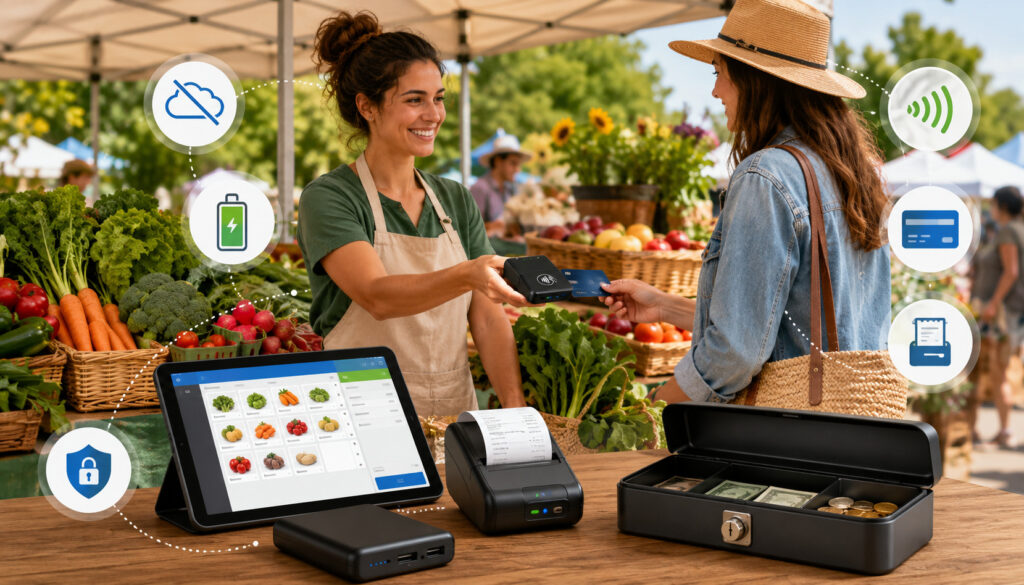
A vendor does not need a permanent checkout counter to operate an organized payment system. A phone, tablet, mobile terminal, secure card reader, charging equipment, and properly configured POS application may be enough.
The central requirement is confirmed offline support. Vendors should not assume that a mobile card reader automatically accepts offline transactions. Mobile simply means the equipment can be used away from a fixed counter.
The POS should clearly display network status, offline transaction status, and synchronization progress. Staff need to know whether a payment is approved, pending, stored, declined, canceled, or duplicated.
Useful equipment may include:
- A compatible phone, tablet, or handheld terminal.
- An approved EMV and contactless card reader.
- A secure POS application with offline support.
- Fully charged power banks.
- Charging cables and adapters.
- A protected mobile hotspot.
- A cash box with change.
- A receipt printer or digital receipt option.
- Weather-resistant device covers.
- A lockable storage container.
- Printed prices and basic sales forms.
- A second authorized device where appropriate.
Inventory and tax settings should be prepared before the market. Trying to update a large product catalog while offline may not work, and incorrect tax or pricing settings can complicate reconciliation.
Mobile POS and Card Reader Requirements
The mobile POS application and reader must work together in offline mode. A vendor should confirm compatibility for the exact phone or tablet model, operating system, app version, and card reader being used.
Modern mobile readers may support EMV chip cards, contactless cards, and digital wallets. However, offline eligibility may differ by entry method. Tap-to-pay may work online but be restricted offline, or the system may allow chip transactions while declining manually entered cards.
Vendors should review:
- Supported card-entry methods.
- EMV chip capability.
- Contactless and digital wallet support.
- Bluetooth or wired connection requirements.
- Offline transaction limits.
- Maximum offline storage time.
- Device and operating-system compatibility.
- Receipt behavior while offline.
- Automatic versus manual syncing.
- Refund handling.
- Reader battery life.
- Software update requirements.
Using secure, approved equipment is part of responsible card acceptance. The PCI Security Standards Council explains that PCI DSS provides baseline technical and operational requirements for protecting payment account data. Its small-merchant payment security resources can help businesses understand core safeguards.
Power, Connectivity, and Backup Supplies
Power management is a major part of mobile credit card processing for farmers markets. Screen brightness, Bluetooth, cellular service, hotspot use, receipt printing, and repeated network searches can drain batteries quickly.
Vendors should charge all devices the night before and carry tested power banks. Charging cables should be labeled and stored where staff can reach them without leaving the booth unattended.
A mobile hotspot can provide backup connectivity, but it should also be charged and tested. Using a hotspot on the same carrier as the primary phone may not help during a carrier outage or coverage gap, so some vendors choose a backup connection from another network.
Other useful supplies include:
- A weather-resistant extension setup where approved.
- Spare receipt paper.
- A printed price list.
- Cash and coins for change.
- A calculator.
- Device stands or straps.
- Screen covers for rain and sunlight.
- A secure cash bag.
- A list of payment support contacts.
- Written offline payment instructions.
Equipment should be placed away from food preparation areas, liquids, direct rain, and unstable table edges. A small canopy leak can damage a terminal or cause the booth to lose its entire payment setup.
Payment Security for Offline Credit Card Processing
Payment security remains important even when a transaction is not immediately transmitted. Offline mode should store transactions through the payment application’s designed security controls, not through handwritten notes, photographs, text messages, or general-purpose spreadsheets.
A secure card reader can encrypt payment data during capture so staff do not directly handle or view complete card information. Tokenization may replace sensitive data with a non-sensitive reference where supported, although the exact security design depends on the payment environment.
PCI compliance responsibilities vary according to the merchant’s setup, equipment, processing methods, and agreements. Vendors should complete the security requirements assigned by their payment provider or acquiring institution and seek qualified guidance when uncertain.
Basic protective practices include:
- Using approved payment equipment.
- Keeping applications and operating systems updated.
- Enabling passcodes and automatic screen locks.
- Restricting staff permissions.
- Avoiding shared user accounts where possible.
- Inspecting card readers for tampering.
- Installing applications only from trusted sources.
- Avoiding unsecured public networks for administrative tasks.
- Securing devices when the booth is crowded.
- Never storing full card details outside the payment system.
The PCI Security Standards Council’s small-merchant guidance explains that encryption makes payment data unreadable without the required key and describes the security value of validated point-to-point encryption solutions.
Protecting Customer Card Data Offline
A vendor should never write down a customer’s full card number, security code, PIN, or other sensitive authentication information to enter later. This creates significant security exposure and may conflict with payment rules and account requirements.
Card details should be captured only through the secure POS application and approved reader. Staff should not photograph cards, copy numbers into a phone’s notes application, send them through messages, or place them in customer spreadsheets.
A handwritten order form may be useful for products, quantities, pickup details, and customer contact information when appropriate. It should not become a substitute for a payment terminal.
Customer contact details should also be collected only when there is a clear business purpose, such as a custom order, receipt request, delivery, or preorder. The vendor should protect that information and avoid collecting more than necessary.
The safest process minimizes exposure. The customer presents the card directly to the secure reader, the system records the transaction, and the vendor sees only the information needed to confirm the sale.
If the terminal cannot securely record an offline transaction, the vendor should request another payment method rather than creating an improvised card record.
Device Security at the Market Booth
Market booths are busy and physically open. Phones and tablets may be placed near customers, staff may move between tables, and payment terminals can be difficult to monitor during a rush.
Every device should use a passcode, biometric lock where appropriate, and a short automatic-lock period. The POS application should require suitable authentication for administrative functions such as refunds, report access, employee management, and account changes.
Staff accounts should have only the permissions needed for their work. A cashier may need to process sales but not change bank information, export customer lists, issue large refunds, or edit account security settings.
Devices should remain attached to a stand, carried by an authorized worker, or stored in a secure area. When the booth closes, the equipment should not be left unattended under the canopy or inside an unsecured vehicle.
Vendors should inspect readers before each market. Loose seals, unexpected attachments, damaged slots, altered keypads, or unfamiliar cables should be investigated before the device is used.
It is also important to know how to remotely lock or erase a lost phone or tablet. Account passwords should be changed promptly if a device containing payment applications is lost or stolen.
Risks of Offline Credit Card Processing
Offline credit card processing provides operational flexibility, but it transfers part of the immediate authorization uncertainty to the vendor. The product may already be gone before the payment service determines that the transaction cannot be approved.
Delayed declines are the most obvious risk, but they are not the only concern. Vendors can also experience duplicate transactions, expired storage windows, lost devices, incomplete syncing, chargebacks, reporting errors, and employee mistakes.
Potential risks include:
- Insufficient funds or available credit.
- Closed, blocked, or expired cards.
- Stolen or fraudulently used cards.
- Transactions exceeding offline limits.
- Repeated attempts that create duplicates.
- A device being damaged before syncing.
- Stored transactions expiring.
- Incomplete batch uploads.
- Missing receipts.
- Disputes over the amount or product.
- Inventory not updating correctly.
- Staff assuming pending sales are approved.
- Delayed deposits and cash-flow uncertainty.
Risk does not make offline mode unusable. It means the vendor should define when it is appropriate and when another payment method is safer.
For example, a $12 produce sale may fit within the business’s risk tolerance, while a $450 custom order may require online authorization, a secure payment link, cash, or another confirmed method.
Delayed Declines and Payment Uncertainty
An offline transaction can be stored successfully but declined later. The customer may have insufficient funds, an expired card, an issuer restriction, suspected fraud activity, or another account issue that the terminal could not confirm without connectivity.
The Federal Trade Commission notes that cards may be declined for several reasons, including expiration, account limits, and suspicious activity.
When a decline occurs after market day, the vendor may have no practical way to contact the customer. Even when contact information is available, payment recovery may take time and may not succeed.
Vendors can reduce exposure by:
- Keeping offline ticket limits modest.
- Avoiding offline acceptance for unusually large orders.
- Syncing as soon as connectivity returns.
- Watching for suspicious purchase behavior.
- Using online authorization whenever possible.
- Requiring a confirmed payment for high-value custom goods.
- Reviewing decline reports immediately.
- Training staff not to override established limits.
A vendor should also distinguish between debit and credit functionality. Some debit transactions depend on online PIN authorization and may not be available offline. The terminal’s supported payment flow should guide the transaction.
Offline mode is most manageable when the vendor accepts that a small percentage of stored transactions may fail and sets limits that prevent one failure from creating a serious loss.
Duplicate Transactions and Sync Errors
Duplicate transactions often occur when staff are uncertain whether the first payment attempt was recorded. A slow screen or disconnected reader may lead the cashier to run the same card again.
When both attempts upload later, the customer may see two charges. This can result in complaints, refunds, chargebacks, and additional administrative work.
To reduce duplicates, staff should:
- Wait for the POS response.
- Look for the offline transaction confirmation.
- Check the recent sales list before retrying.
- Avoid switching devices mid-transaction.
- Record unresolved incidents.
- Review synced transactions promptly.
- Refund confirmed duplicates through the POS.
- Keep the customer’s receipt reference when available.
Multiple devices can create additional confusion if each stores transactions separately. Vendors should know whether sales reports combine across devices and whether every device must reconnect independently.
Sync failures can also occur when the application is closed too soon, the device loses power, or connectivity drops during upload. A vendor should keep the POS open and powered until the system confirms that all offline transactions have been submitted.
Best Practices for Offline Payments at Farmers Markets
The most effective offline payment procedures are simple enough for staff to follow during a crowded market. They should define how to start offline mode, identify a stored transaction, apply limits, provide receipts, reconnect, and review results.
Recommended practices include:
- Test offline mode before market day.
- Confirm supported cards and entry methods.
- Review per-transaction and cumulative limits.
- Keep devices and power banks charged.
- Use secure, approved readers.
- Never write down full card information.
- Keep offline ticket sizes reasonable.
- Provide receipts whenever possible.
- Sync transactions as soon as practical.
- Check for declines after syncing.
- Maintain a cash backup.
- Carry a tested mobile hotspot.
- Train every authorized cashier.
- Restrict refund and administrative permissions.
- Reconcile sales after every market.
- Review duplicates, disputes, and failed uploads.
- Update software before the event, not during the rush.
- Keep devices protected from weather and theft.
The procedures should match the products being sold. A vegetable vendor may set one offline limit, while a craft vendor with higher-value products may use a lower tolerance for unconfirmed transactions.
Vendors can also review guidance on contactless and farmers market credit card processing when deciding how chip cards, digital wallets, and mobile readers fit into their checkout workflow.
Testing Offline Mode Before Market Day
Testing should take place before the vendor depends on offline processing in front of customers. Staff should practice with the actual phone, tablet, terminal, reader, user account, and receipt method that will be used at the booth.
A useful test covers:
- Disconnecting the device from Wi-Fi and cellular data.
- Confirming that the POS recognizes offline status.
- Entering a low-value test transaction through an approved method.
- Confirming that the transaction is stored.
- Checking whether inventory updates locally.
- Reviewing receipt options.
- Reconnecting the device.
- Watching the transaction sync.
- Confirming its final status.
- Reviewing reports and refund procedures.
Refund testing may require a properly authorized test or completed transaction. Vendors should follow their provider’s instructions rather than creating improper payment activity.
Staff should also practice situations where the reader disconnects, the battery becomes low, or the app is closed. The goal is to understand what the system actually does, not merely what the feature description promises.
Testing should be repeated after major software updates, new equipment, account changes, or long periods when offline mode has not been used.
Syncing Transactions Quickly After the Market
Stored transactions should be uploaded as soon as a stable connection is available. Quick syncing reduces the period in which the vendor does not know whether payments have been approved.
A vendor might reconnect during a quiet market period, from a secure hotspot, at the market office, or immediately after returning to a dependable network. The device should remain charged and the application should stay open until the upload is complete.
After syncing, review the report rather than relying on a general success message. Confirm the number and value of stored transactions against the number and value of approved transactions.
Investigate any difference. A transaction may be declined, duplicated, missing, or still pending.
Prompt review also improves customer service. If a duplicate appears or a digital receipt fails, the vendor can address the issue while the details are still easy to remember.
Transactions should not remain indefinitely on a device. Storage deadlines and upload requirements vary, and waiting too long may increase the likelihood that a transaction cannot be processed.
Offline Payment Limits and Vendor Policies
An internal offline payment policy helps staff make consistent decisions. Without one, employees may accept a large offline purchase because the customer is waiting, another cashier may refuse a similar purchase, and a third may retry the card several times.
The policy can define:
- Maximum offline transaction amount.
- Maximum cumulative offline sales.
- Eligible product categories.
- Restricted high-value products.
- Required manager approval.
- Supported card-entry methods.
- Receipt procedures.
- When customer contact details may be requested.
- When to switch to cash or another payment method.
- How to record unresolved transactions.
- How quickly devices must be synced.
- How declines, refunds, and duplicates are reviewed.
Policies should reflect the vendor’s actual financial capacity. A transaction limit that is suitable for a large operation may be too risky for a seasonal seller with narrow margins.
The payment system itself may impose mandatory limits. Internal limits should not exceed provider or terminal rules.
Staff should understand that declining an offline transaction does not mean accusing the customer of wrongdoing. It simply means the business cannot confirm the payment under current network conditions.
Setting a Sensible Offline Transaction Limit
A sensible limit considers average sale value, product cost, replacement difficulty, profit margin, fraud exposure, and the likelihood of recovering payment.
Suppose a vendor’s typical purchase is $18 and most products are low-cost produce. A moderate offline limit may allow normal transactions while excluding unusually large purchases.
A vendor selling handmade goods or bulk food orders may choose a lower offline limit relative to the value of the merchandise because one delayed decline could represent a significant loss.
A tiered policy can be useful:
- Normal low-value sales may be accepted offline.
- Mid-value sales may require a manager’s review.
- High-value sales may require online authorization or another payment method.
- Custom orders may require a secure deposit before production or delivery.
The exact amounts should be determined by the business, its payment agreement, and its risk tolerance. They should not be copied from another vendor without considering differences in products and margins.
Limits can also be adjusted by location. A market with frequent outages may require stricter controls than a location where offline mode is used only for brief interruptions.
Explaining Offline Payments to Customers
Customers generally do not need a technical explanation. A brief, confident statement is usually enough.
A cashier might say that the network is temporarily unavailable, the secure terminal can record eligible purchases, and the receipt may arrive after the connection returns. For a larger order, the cashier might explain that the business needs a confirmed payment and offer cash, a secure payment link, or another available method.
Communication should avoid implying that a transaction is approved when it is still pending. It should also avoid alarming the customer with unnecessary security terminology.
Useful points to communicate include:
- The connection is temporarily unavailable.
- Eligible payments may be recorded securely.
- Receipt delivery may be delayed.
- Larger purchases may require another payment method.
- The customer should not tap or insert the card multiple times.
- The vendor can help if a duplicate charge later appears.
Clear communication supports trust and reduces disputes. The customer should know the amount being recorded and should receive evidence of the purchase where possible.
Receipts, Refunds, and Customer Communication
Receipts provide a record of the purchase amount, date, products, payment method, and vendor identity. They are useful when customers ask about a delayed charge, duplicate transaction, exchange, refund, or unfamiliar statement description.
Offline receipt functionality differs between systems. A terminal with a built-in printer may produce a receipt immediately. A mobile POS may queue an email or SMS receipt until connectivity returns.
The vendor should understand whether digital receipt information is stored with the pending payment and whether delivery happens automatically after syncing.
Receipts should not expose full card numbers or sensitive authentication information. Properly designed payment receipts generally display only limited card details.
Refunds require additional care. A vendor should confirm that the original transaction was approved and settled before issuing a refund. Refunding a transaction that never completed can create reporting errors or unnecessary loss.
Customer communication records can be useful for custom orders, deliveries, or disputed transactions. Those records should include only necessary information and should be stored securely.
Giving Receipts During Offline Transactions
Whenever possible, provide the customer with a receipt or other transaction confirmation. This can help establish the agreed amount and reduce confusion when the charge appears later.
A receipt may be:
- Printed by the terminal.
- Printed by a connected receipt printer.
- Emailed after synchronization.
- Sent by SMS after synchronization.
- Generated as an order record without sensitive card data.
If the digital receipt will be delayed, tell the customer. The vendor can also display a return or contact policy at the booth so the customer knows how to report an issue.
Staff should verify that the receipt total matches the sale. Incorrect item entry or duplicate tips can create disputes even when the card payment itself works correctly.
The vendor’s business name or statement description should be recognizable where possible. Customers are more likely to question a charge when the name on their statement does not resemble the booth or farm they visited.
Receipt information should be kept long enough to support normal accounting, refund, tax, and dispute procedures, subject to applicable business requirements.
Handling Refunds After Offline Transactions
Before processing a refund, locate the original sale and check its final status. An offline transaction may appear in the order history even though it was later declined.
If the original transaction was not approved, the vendor should not issue a separate card refund. Instead, the records should show that no completed payment was received.
For approved transactions, refunds should usually be processed through the same secure POS system and linked to the original transaction when possible. This creates a clearer record than sending money through an unrelated channel.
Maintain notes for:
- Product returns.
- Customer exchanges.
- Duplicate charges.
- Partial refunds.
- Canceled custom orders.
- Declined offline payments.
- Receipt corrections.
- Customer communications.
Refund timing should be communicated accurately. A vendor may initiate a refund promptly, but the customer’s financial institution controls when the credit becomes visible.
Staff should not improvise refund methods during a busy market. A manager or authorized user should review unusual or high-value requests.
Fraud Prevention for Offline Farmers Market Payments
Offline transactions deserve additional attention because the issuer cannot complete the normal real-time authorization process while the device is disconnected.
Most farmers market customers are legitimate shoppers. Fraud prevention should therefore be calm, consistent, and based on behavior and transaction risk rather than assumptions about individuals.
Warning signs may include an unusually large purchase that does not match normal customer behavior, repeated attempts using different cards, pressure to bypass receipt procedures, or requests to split one large purchase across many transactions.
Fraud prevention controls can include:
- Offline transaction limits.
- Manager approval for unusual sales.
- Restrictions on manual card entry.
- Secure card-reader use.
- Staff training.
- Prompt transaction syncing.
- Review of repeated declines.
- Clear refund controls.
- Device inspection.
- Accurate receipts.
- Documented procedures for suspicious transactions.
Employee awareness is important. The FTC recommends training staff as part of protecting small businesses from scams and fraudulent activity.
Fraud controls should not involve writing down card information or keeping copies of cards. Those practices create security risk rather than reducing it.
Red Flags During Offline Card Payments
A red flag does not prove fraud, but it may justify pausing the transaction and requesting online authorization or another payment method.
Examples include:
- A purchase far larger than the vendor’s usual sale.
- Multiple cards failing or being replaced rapidly.
- Pressure to skip the receipt.
- Requests to enter card information manually when the card can be presented.
- Attempts to divide a large transaction to avoid a limit.
- A customer rushing staff or discouraging normal checks.
- A custom order with inconsistent contact information.
- Unusual refund requests immediately after purchase.
- Attempts to take possession of high-value goods before payment is confirmed.
Staff should not confront or accuse the customer. They can simply explain that the connection is unavailable and the business requires another payment method for that transaction.
The policy should be applied consistently. If high-value offline transactions require manager approval, that rule should apply regardless of who is making the purchase.
A vendor may also decide that certain products will never be released on an unconfirmed offline payment. That can be appropriate for scarce, custom-made, expensive, or difficult-to-recover goods.
Staff Training for Offline Payment Risk
Training should cover both technical steps and judgment. Staff need to know how to identify offline status, record a transaction, confirm it was stored, provide a receipt, avoid duplicates, and report anything unusual.
They should also know when to stop. Examples include:
- The transaction exceeds the offline limit.
- The reader shows an error rather than a stored payment.
- The customer requests repeated retries.
- The device cannot protect or save the transaction.
- The purchase is unusually large.
- The card-entry method is not eligible offline.
- The terminal appears damaged or altered.
- Staff are unsure whether the payment succeeded.
A simple escalation process can prevent rushed decisions. The cashier can call the booth manager, request cash, use a backup hotspot, or send a secure payment link for an appropriate order.
Seasonal employees should receive the same training as regular staff. A short role-playing exercise before opening can reveal confusion that written instructions do not address.
Training records and updated procedures are particularly helpful when a business operates at multiple markets or uses different teams throughout the season.
Reporting and Reconciliation After Market Day
Reconciliation confirms that recorded sales, approved card payments, cash, refunds, taxes, tips, inventory changes, and bank deposits agree.
Offline transactions add another layer because the sales may be recorded at one time, authorized later, batched later, and deposited on a different day.
After each market, the vendor should separate:
- Cash sales.
- Online card sales.
- Offline stored transactions.
- Offline approved transactions.
- Offline declined transactions.
- Pending transactions.
- Refunds.
- Tips.
- Taxes.
- Discounts.
- Voids.
- Duplicate charges.
- Fees where shown.
- Expected deposits.
The POS report should be compared with the market’s internal sales record. If inventory tracking is used, quantities sold should also match item-level transactions.
A completed transaction is not necessarily deposited for the same gross amount because refunds, chargebacks, fees, adjustments, and batch timing may affect funding. Vendors should understand how their reports present these items.
Regular reconciliation makes errors easier to identify. Waiting until the end of the month can make it difficult to remember which device, staff member, market, or network problem affected a transaction.
Matching Offline Sales to Deposits
Start with the offline transaction report. Note the number of transactions, gross value, approval status, and upload time.
Then compare approved offline sales with the processor’s batch or settlement report. Confirm that they were included in an expected funding batch.
Next, compare the expected net deposit with the bank account. Differences should be explained by fees, refunds, reserve activity, chargebacks, adjustments, or timing.
A reconciliation record might include:
- Market date and location.
- Device used.
- Total offline transactions recorded.
- Total approved after syncing.
- Total declined.
- Duplicate transactions refunded.
- Batch identifier.
- Expected deposit.
- Actual deposit.
- Notes about unresolved differences.
Declined offline transactions should not remain mixed with completed revenue in accounting records. The vendor may need to adjust sales, receivables, inventory, or loss records according to its normal accounting process.
For significant discrepancies, the vendor should contact the payment service or an accounting professional with the transaction report available.
Tracking Products Sold During Offline Mode
Inventory tracking can be affected when devices operate offline. Some POS systems update inventory locally and synchronize later. Others may not reflect changes across multiple devices until all devices reconnect.
This creates a risk of overselling, particularly for limited goods such as reserved meat packages, specialty baked items, flower arrangements, handmade crafts, or preordered boxes.
Vendors should determine whether offline sales reduce inventory immediately on the local device and how those changes merge with online sales from other devices.
At the end of the market:
- Count high-value or limited inventory.
- Compare physical stock with POS quantities.
- Review offline item sales.
- Resolve duplicate or canceled transactions.
- Record spoilage, samples, and damaged products separately.
- Confirm taxes and discounts.
- Update preorder availability.
- Investigate negative inventory.
Perishable inventory needs special attention because unsold, damaged, or donated products may also affect the count. A payment report alone cannot explain every difference.
A reliable farmers market checkout system should make it reasonably easy to connect payments with products, even when transactions are synchronized later.
Common Mistakes to Avoid With Offline Card Payments
One of the most common mistakes is assuming that every mobile POS includes offline processing. Vendors may discover during an outage that their system requires an active connection for all card transactions.
Another mistake is treating a stored offline sale as a guaranteed payment. The terminal may have captured the transaction correctly, but approval can still fail after syncing.
Other frequent problems include:
- Not enabling offline mode before the event.
- Failing to test the reader and device.
- Ignoring time or transaction limits.
- Allowing excessive offline ticket amounts.
- Repeatedly retrying the same payment.
- Closing the application before syncing finishes.
- Waiting several days to reconnect.
- Using devices with low battery.
- Forgetting the hotspot charger.
- Skipping receipts.
- Sharing unrestricted staff logins.
- Writing down card information.
- Failing to review declines.
- Neglecting inventory updates.
- Not matching settlements to deposits.
These mistakes are preventable with preparation. A brief pre-market equipment check and a post-market reconciliation routine can resolve many problems before they affect customers or cash flow.
Waiting Too Long to Sync Transactions
Delayed syncing extends the period of uncertainty. The vendor does not know which transactions are approved, and the customer may not see the final charge or receive a queued receipt.
Payment systems may impose deadlines for submitting stored transactions. A device that is lost, damaged, reset, logged out, or updated before synchronization could also create complications.
Waiting too long makes customer questions harder to answer. Staff may no longer remember the transaction, product, receipt, or reason a card was retried.
The safer approach is to reconnect as soon as practical using a trusted network. Keep the device powered, open the application, confirm that all stored transactions upload, and review the results.
If transactions cannot sync, document the issue and contact the payment service promptly. Do not erase the application, factory-reset the device, or repeatedly reinstall software unless instructed by qualified support, because stored transaction data may be affected.
Fast syncing does not guarantee approval, but it provides faster visibility and more time to respond to problems.
Treating Offline Payments Like Guaranteed Payments
Offline processing can feel successful because the customer’s card was accepted by the reader and the POS produced a confirmation. That confirmation may indicate only that the payment was stored.
Staff should use accurate language. “Recorded” or “saved offline” is different from “approved.”
This distinction affects:
- Revenue reporting.
- Inventory release.
- Custom orders.
- High-value purchases.
- Customer receipts.
- Refund decisions.
- Deposit expectations.
The vendor should not count unapproved offline transactions as final available cash until the system has synchronized and the payment has entered the normal processing flow.
Even approved transactions can later be disputed, just as online transactions can. Receipts, accurate product descriptions, clear return policies, and transaction records remain important.
Offline mode is a continuity tool, not a guarantee. Businesses that understand that limitation can use it more responsibly.
Offline Credit Card Processing Checklist for Farmers Market Vendors
A repeatable checklist helps vendors prepare equipment and staff before each market. It is particularly useful at unfamiliar locations, seasonal festivals, holiday markets, and events where network demand may be unusually high.
| Checklist Area | What to Check | Why It Matters |
| Offline mode | Confirm the POS supports and enables offline payments | Prevents checkout surprises |
| Device power | Charge phones, tablets, readers, hotspots, and power banks | Keeps the booth operating |
| Transaction limits | Review provider and internal offline maximums | Reduces potential decline losses |
| Receipts | Test printed, emailed, or SMS receipts | Supports customer confidence and records |
| Security | Use approved readers, passcodes, and restricted accounts | Protects payment and business information |
| Connectivity backup | Test a hotspot or alternate network | Helps restore real-time authorization |
| Staff training | Practice offline sale, retry, and escalation procedures | Reduces mistakes during busy periods |
| Sync process | Know how and when stored transactions upload | Confirms approvals promptly |
| Reconciliation | Compare sales, approvals, refunds, and deposits | Identifies errors quickly |
| Customer support | Maintain a clear contact and refund process | Helps resolve duplicates and disputes |
This checklist can be adapted to the booth’s products and equipment. Vendors using several devices may need a separate line for each device, reader, charger, and user account.
How to Use the Checklist Before Each Market
Complete the checklist before loading equipment whenever possible. Fixing a login problem or missing software update is easier at home than at a booth with customers waiting.
At the market, repeat a brief location-specific check:
- Confirm signal quality.
- Test the hotspot.
- Verify reader connection.
- Check battery levels.
- Confirm offline settings.
- Review the transaction limit.
- Make sure cash and change are available.
- Place the receipt supplies where staff can reach them.
- Review the escalation procedure.
- Inspect the device for damage or tampering.
New locations deserve additional testing. A market may have strong service near the entrance but poor coverage at the assigned booth.
Busy seasonal events may also require larger power reserves and stricter transaction controls because network congestion and higher ticket amounts can occur together.
The checklist should be signed or initialed by the person responsible for opening the booth. This creates accountability and makes recurring equipment problems easier to identify.
Records to Keep After Each Market
Post-market records help the vendor understand sales performance, investigate payment issues, prepare accounting entries, and respond to customer questions.
Useful records include:
- Daily POS sales reports.
- Offline transaction reports.
- Approval and decline results.
- Batch and settlement summaries.
- Deposit reports.
- Cash count sheets.
- Refund and void records.
- Duplicate-charge notes.
- Customer receipts.
- Inventory reports.
- Tax and tip totals.
- Staff incident notes.
- Customer communications related to disputes.
- Equipment or connectivity problems.
Payment records should be stored securely. Reports should not contain unnecessary sensitive card data, and access should be limited to authorized people.
The retention period can depend on accounting, tax, contractual, dispute, and operational requirements. Vendors should establish a consistent recordkeeping policy suited to their circumstances.
A short market summary is also useful. Recording signal quality, hotspot performance, battery use, and checkout problems can guide future equipment decisions.
How to Choose Farmers Market POS Systems With Offline Payment Support
Choosing a farmers market POS system involves more than comparing transaction rates or hardware prices. The system must function in the vendor’s actual selling environment.
Offline support should be evaluated in detail. Ask whether it applies to the specific terminal and card reader, which card-entry methods are supported, how long transactions can remain stored, and what happens when a payment is declined after syncing.
Other important features include:
- EMV chip support.
- Contactless card and digital wallet acceptance.
- Mobile-device compatibility.
- Battery performance.
- Easy network-status indicators.
- Digital and printed receipts.
- Inventory tracking.
- Tax settings.
- Tip and discount controls.
- Refund and exchange tools.
- Multiple staff accounts.
- Permission controls.
- Sales and settlement reporting.
- Hotspot compatibility.
- Transparent fees.
- Funding timelines.
- Accessible support.
- Secure hardware and encryption.
Vendors comparing POS systems for farmers markets should test the checkout workflow rather than relying only on a feature list. A powerful system may still be unsuitable if staff cannot identify offline transactions or complete sales quickly.
Questions to Ask Before Choosing a POS System
Before selecting equipment, ask specific questions such as:
- Does the system support true offline card processing?
- Which devices and readers support it?
- Must offline mode be enabled in advance?
- Which cards and entry methods are eligible?
- Are EMV payments for farmers markets supported offline?
- Are contactless cards or digital wallets supported offline?
- What is the maximum offline transaction amount?
- Is there a cumulative offline limit?
- How long can transactions remain stored?
- What happens if the device is lost before syncing?
- Does syncing happen automatically?
- How are declines displayed?
- Can receipts be printed while offline?
- When are digital receipts delivered?
- How are duplicate transactions identified?
- Can refunds be linked to the original sale?
- Do inventory and tax reports update correctly?
- Are staff permissions available?
- What security requirements apply?
- What support is available during market hours?
- How are offline sales funded?
- Are there additional fees or account restrictions?
Answers should be obtained in writing where possible. Marketing terms such as “mobile,” “wireless,” and “works anywhere” do not necessarily confirm offline functionality.
Comparing Ease of Use, Security, and Reliability
Price matters, but the lowest-cost option is not automatically the most suitable. A failed checkout system can affect sales, customer confidence, bookkeeping, and staff productivity.
Ease of use includes clear product buttons, readable totals, simple receipt options, visible network status, and obvious offline confirmations. Seasonal workers should be able to understand the basic workflow without extensive technical training.
Security includes approved card readers, encryption, protected user accounts, software updates, device controls, and suitable payment-data handling. The FTC’s business guidance also emphasizes that customer charges must be authorized, including charges made through mobile payment environments.
Reliability includes battery life, Bluetooth stability, hotspot compatibility, transaction storage, accurate syncing, and dependable reporting.
Customer support can become especially important when stored transactions do not upload. Vendors should know when assistance is available and what information support will need.
A balanced choice supports the vendor’s normal online checkout while also providing a controlled offline fallback.
Frequently Asked Questions
What is offline credit card processing at farmers markets?
Offline credit card processing at farmers markets is a payment capability that allows an eligible POS application or terminal to record card transactions while internet or cellular service is unavailable.
The transaction is securely stored by the supported payment system and uploaded after the device reconnects. Authorization may not be completed until that upload occurs.
Offline processing can help vendors continue accepting eligible card payments during temporary outages, but it creates a risk that a transaction will later be declined.
How does offline credit card processing work?
The vendor enters the sale in the POS, accepts the card through an approved reader, and confirms that the system has stored the transaction in offline mode.
When connectivity returns, the POS sends the stored transaction for authorization and processing. Approved transactions proceed toward settlement, while declined transactions may leave the vendor without payment for goods already released.
The exact process, time limit, supported card type, and transaction limit depend on the payment system and merchant setup.
Can farmers market vendors accept cards without internet?
Some vendors can accept eligible cards without an active internet connection when their mobile POS, card reader, payment account, and transaction type support offline mode.
Not every system provides this feature. Some mobile payment tools require an active connection for every authorization.
Vendors should test offline mode before the market and maintain cash, backup connectivity, or another suitable payment option in case the device cannot record the transaction.
Are offline card payments approved immediately?
Not always. Many offline transactions are stored first and submitted for approval after the device reconnects.
That means a transaction may appear successful at the booth but later be declined. Vendors should understand what their POS confirmation means and avoid describing a stored transaction as fully approved.
Prompt syncing and reasonable offline limits can reduce the business impact of delayed declines.
What are the risks of offline payments for farmers markets?
The main risks include delayed declines, insufficient funds, fraudulent card use, expired cards, duplicate transactions, unsynced payments, device loss, chargebacks, reporting errors, and settlement delays.
There is also a risk that staff may release high-value goods before authorization is confirmed. These risks can be managed through transaction limits, secure readers, staff training, fast syncing, clear receipts, fraud awareness, and regular reconciliation.
What tools are needed for offline farmers market POS payments?
A typical setup includes a compatible mobile POS application, approved card reader or payment terminal, phone or tablet, charged batteries, power banks, receipt options, and a reliable way to reconnect.
A mobile hotspot, cash box, charging cables, printed prices, secure device stand, and weather protection are also useful. The vendor must confirm that the exact hardware and account configuration support offline processing.
How can vendors reduce declined offline payments?
Vendors can reduce exposure by keeping offline transaction sizes reasonable, avoiding offline acceptance for unusual high-value purchases, using online authorization whenever possible, and syncing transactions quickly.
Staff should watch for repeated card attempts, unusually large orders, and attempts to bypass normal checkout procedures. A backup hotspot may restore online authorization and allow the vendor to confirm higher-risk transactions before releasing the goods.
Conclusion
Offline credit card processing at farmers markets can help vendors continue serving customers when Wi-Fi or cellular service becomes weak, congested, or temporarily unavailable. It can be particularly valuable at rural markets, outdoor events, temporary booths, seasonal festivals, and busy locations where customers expect to pay by card.
The feature works by securely recording eligible transactions on a supported POS device and uploading them after connectivity returns. Because authorization may be delayed, an offline transaction is not automatically a guaranteed payment.
Responsible use requires preparation. Vendors should confirm that their system supports offline card payments, understand the applicable limits, test the complete process, use secure readers, protect devices, provide receipts, train staff, and sync transactions as quickly as possible.
Offline processing should also be supported by other continuity tools. Cash, charged power banks, a mobile hotspot, alternate payment methods, clear signage, and written procedures can help the booth operate through different types of disruption.
After every market, vendors should review approvals, declines, refunds, duplicate charges, inventory changes, settlement reports, and bank deposits. Regular reconciliation turns offline payments from an uncertain emergency measure into a controlled part of farmers market payment processing.
The most suitable setup is not necessarily the one with the longest feature list. It is the one that matches the vendor’s market environment, average transaction size, product value, customer expectations, security needs, and everyday checkout workflow.