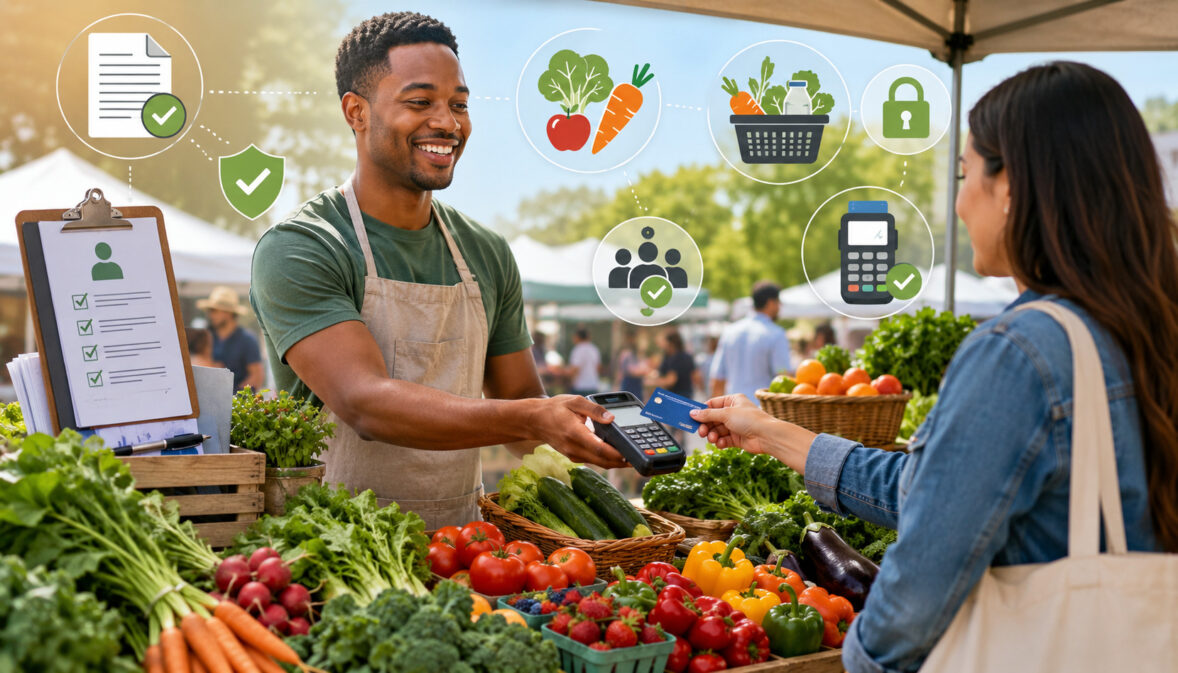
Farmers markets connect shoppers with fresh produce, locally raised foods, seasonal ingredients, and small agricultural businesses. For households using food assistance benefits, these community markets can also provide convenient access to fruits, vegetables, dairy products, eggs, meat, bread, and other foods intended for preparation at home.
Accepting electronic benefits transfer payments, however, involves more than purchasing a card reader and displaying a sign.
Vendors and market operators must understand the USDA SNAP requirements for farmers market vendors, including authorization, product eligibility, transaction procedures, equipment, recordkeeping, employee training, refunds, token management, and vendor reimbursement.
The exact responsibilities depend heavily on how the market is organized. An individual farmer may process SNAP through an authorized vendor account, while a multi-vendor market may operate a central EBT booth and issue tokens or scrip that shoppers use with participating vendors.
In either arrangement, SNAP benefits may only be accepted by an authorized entity and used for eligible purchases. The payment process must also protect customer information, produce accurate transaction records, and prevent food assistance benefits from being exchanged for cash or used for non-eligible products.
Understanding these requirements helps vendors avoid checkout confusion, incorrect reimbursements, rejected transactions, and compliance problems. It also creates a more respectful and predictable shopping experience for customers.
This guide provides general educational information rather than legal advice. Vendors and market managers should confirm current requirements through the official SNAP retailer information, the appropriate program administrator, and their EBT processing provider before accepting benefits.
Retailer requirements and state-specific purchase restrictions may change, making regular review especially important.
What Are USDA SNAP Requirements for Farmers Market Vendors?
USDA SNAP requirements for farmers market vendors are the authorization, product eligibility, transaction, equipment, operational, and recordkeeping rules that apply when a vendor or market accepts food assistance benefits.
These requirements are intended to ensure that benefits are accepted only by approved retailers, used only for qualifying food purchases, and processed through authorized electronic benefits transfer systems.
They may apply to individual farmers, food producers, market organizations, nonprofit market operators, or another entity responsible for the market’s central EBT program.
The first major requirement is authorization. Selling food at a farmers market does not automatically give a business permission to accept SNAP. The entity processing the customer’s EBT card must generally be approved through the SNAP retailer authorization process.
The second requirement is product eligibility. Even an authorized retailer cannot process SNAP for every item sold at a market. Vendors must distinguish SNAP eligible foods from crafts, household products, alcohol, hot foods, decorative plants, and other non-eligible merchandise.
Other important areas include:
- Using approved EBT equipment and transaction services.
- Following the market’s token or scrip procedures.
- Keeping accurate payment and reimbursement records.
- Training staff to identify qualifying products.
- Handling refunds and corrections properly.
- Protecting customer account information.
- Reconciling transactions after each selling day.
- Following changes communicated through official program guidance.
Farmers market SNAP requirements can look different from one location to another. A direct-processing vendor may be responsible for the entire transaction, while vendors participating in a central market system may never handle the customer’s EBT card.
SNAP Authorization vs General Market Participation
Permission to sell at a market and permission to accept SNAP are two separate matters. A market manager may approve a farmer, baker, meat producer, or food vendor to rent a booth, but that approval does not make the vendor a SNAP-authorized retailer.
When vendors accept benefits through their own terminals, they generally need appropriate authorization connected to their business and approved selling location. They must also use payment equipment configured for SNAP transactions and follow the conditions attached to that authorization.
In a centralized system, the farmers market organization may become the authorized entity. Customers process their EBT cards at a central station and receive tokens, paper scrip, or another approved form of market currency. Participating vendors accept that currency instead of processing EBT cards individually.
The market must then control which vendors can accept the currency, explain which products qualify, collect redeemed tokens, and reimburse vendors from the corresponding EBT proceeds.
A vendor should never assume that participation under one market’s central authorization allows direct SNAP acceptance elsewhere. Authorization may be connected to a particular business, ownership structure, location, or operating arrangement.
Why Requirements Matter for Vendors and Market Managers
SNAP rules protect customers by helping ensure that benefits remain available for qualifying food purchases. They also protect vendors and market organizations by creating a documented process for accepting payments and distributing funds.
Without clear procedures, a mixed-product vendor could accidentally accept tokens for soap, decorative flowers, or a hot meal. A market employee might issue the wrong amount of scrip, while a manager could reimburse a vendor without verifying the number of tokens redeemed.
Weak controls may lead to:
- Incorrect customer charges.
- Improper sales of non-eligible products.
- Missing or duplicated vendor reimbursements.
- Disputes over tokens and market currency.
- Inaccurate settlement reports.
- Confusion about refunds.
- Poor documentation during a review.
- Losses caused by counterfeit or unauthorized tokens.
Clear rules are especially important at busy markets where seasonal employees, volunteers, and temporary vendors may handle transactions. Written procedures give everyone the same instructions and reduce dependence on verbal explanations.
Responsible farmers market vendor compliance is not only about avoiding violations. It supports customer trust, accurate accounting, reliable vendor payouts, and consistent food access throughout the market season.
How SNAP EBT Works at Farmers Markets
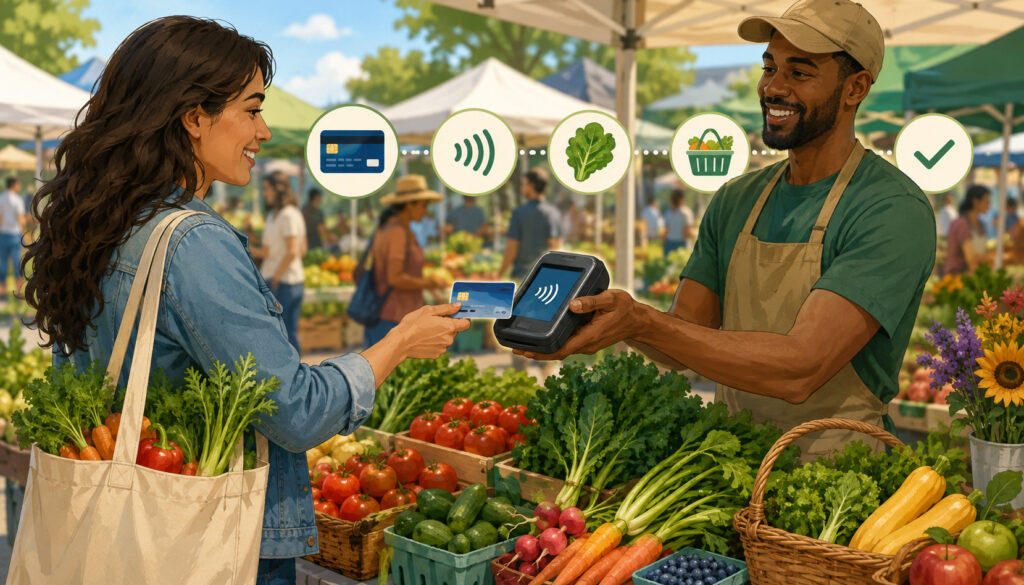
Electronic benefits transfer allows a qualifying customer to access food assistance benefits through an EBT card and personal identification number. At a farmers market, the card may be processed at an individual vendor booth or at a centralized market station.
The customer chooses eligible food items, and the authorized retailer initiates the SNAP transaction. The system checks the available benefit balance and, when approved, deducts the purchase amount. The transaction should be completed only for qualifying products.
In a direct setup, the vendor hands the customer a receipt when the equipment supports one and records the sale in the vendor’s reporting system. Settlement is then handled through the approved EBT arrangement.
In a centralized system, the first transaction generally converts part of the shopper’s available benefit balance into market tokens or scrip. The customer uses that market currency with approved vendors, and the market later reimburses each vendor for properly redeemed currency.
Nutrition incentive programs may operate alongside SNAP. For example, a customer may receive additional market currency for qualifying produce purchases. Incentive funds should be tracked separately from the underlying SNAP transaction when required by the applicable program.
Vendors should consult current guidance before assuming that ordinary credit card features also work for SNAP. EBT transactions have distinct authorization, product eligibility, refund, and benefit-account rules.
Market-Level SNAP EBT Systems
In a market-level system, the customer usually visits an information booth or dedicated EBT station. A trained employee or volunteer processes the EBT card for an amount selected by the customer, subject to the available balance.
The market then issues tokens, paper scrip, or approved market currency equal to the authorized amount. Customers spend that currency at participating booths offering SNAP eligible foods.
This arrangement can make accepting SNAP at farmers markets more practical because the market maintains one central terminal instead of requiring every vendor to obtain separate equipment. It can also create a consistent customer service point for questions, balance inquiries, transaction corrections, and nutrition incentives.
However, central processing gives the market manager substantial responsibilities. The market must control access to the terminal, secure the tokens, maintain issuance records, train participating vendors, monitor eligible purchases, and reconcile issued and redeemed currency.
Token design should make denominations easy to identify while discouraging unauthorized duplication. Written rules should address whether change may be given, whether unused tokens can be returned, and whether tokens remain valid at future markets.
Vendor-Level SNAP EBT Systems
Some farmers and food vendors accept SNAP directly through their own authorized payment arrangements. This can be useful for vendors who sell at multiple locations, operate a farm stand, participate in several markets, or want to manage their own settlement records.
The vendor selects the qualifying products, enters the correct SNAP total, and asks the customer to complete the EBT transaction. Non-eligible products must be separated and paid for with another payment method.
Direct processing gives the vendor immediate visibility into transactions and reduces reliance on market reimbursement. It may also eliminate the need to count and redeem tokens.
The vendor must nevertheless take responsibility for authorization, terminal configuration, staff training, receipts, refunds, reporting, reconciliation, and secure device handling. A general mobile card reader should not be assumed to support SNAP merely because it accepts debit cards.
Vendors comparing technology should confirm that the system is compatible with the approved EBT arrangement. General information about choosing a portable mobile POS for farmers markets can help identify useful features, but SNAP functionality must be verified separately.
Who Needs SNAP Authorization at a Farmers Market?
The entity that processes SNAP benefits generally needs authorization. Determining who that entity is should be one of the first planning decisions made by vendors and market organizers.
Possible applicants may include:
- An individual farmer or producer.
- A food vendor operating independently.
- A farmers market organization.
- A nonprofit organization managing the market.
- A public agency operating a market.
- Another eligible entity responsible for central EBT processing.
The application process evaluates whether the applicant and retail operation meet applicable participation requirements. The official Retailer Service Center identifies the SNAP retailer application as Form FNS-252 and instructs applicants to complete it accurately and follow the provided application directions.
Authorization should be completed before processing benefits. Vendors should also report material changes when required, such as changes in ownership, operating structure, business location, or market arrangement.
Retail eligibility standards can be updated. Official guidance currently notes changes to staple-food stocking standards with a scheduled compliance date, so applicants and existing retailers should verify which requirements apply at the time of application or reauthorization.
Individual Vendor Authorization
Individual authorization may be appropriate when a farmer or food seller wants to process benefits at the booth using an EBT terminal or compatible mobile device.
The applicant may need to provide information about the business, ownership, selling locations, products, operating schedule, and other details requested during the retailer review. Supporting documentation may also be required to verify identity, ownership, or business activity.
Authorization is not based only on whether a vendor sells one qualifying item. Retail participation standards may consider staple-food inventory or the proportion of sales represented by staple foods. Official requirements recognize different eligibility pathways, commonly described as staple-food stock and staple-food sales criteria.
Farmers and direct producers should use application instructions designed for their type of operation whenever available. They should also make sure the application accurately describes what they sell rather than treating every product at the booth as SNAP eligible.
Once authorized, the vendor must continue following applicable program requirements. Approval is not a one-time exemption from future monitoring, reauthorization, or operational changes.
Farmers Market Organization Authorization
A market organization may apply as the authorized retailer when it operates a central SNAP system for participating vendors. This model is often used by community markets with numerous small producers that would otherwise need separate equipment and authorization.
The organization becomes responsible for processing customer EBT transactions and administering the market currency system. Vendors receive payment from the organization after surrendering valid tokens or documenting other approved transactions.
The market should maintain a current list of participating vendors and the products they sell. Vendors offering only crafts, prepared hot meals, decorative goods, or other non-eligible products should not accept SNAP-funded market currency.
If a market operates in multiple places, separate authorization or licensing arrangements may be necessary. Market organizers should describe all operating locations accurately and confirm the applicable process before expanding.
Central authorization does not remove the need for vendor accountability. Each participating seller should sign an agreement acknowledging eligible-product rules, token restrictions, redemption procedures, and consequences for misuse.
Common SNAP Eligible Foods at Farmers Markets

SNAP generally covers foods intended for household consumption. Farmers markets are well positioned to offer these products because many participating vendors sell staple ingredients, fresh produce, and foods that customers take home to prepare.
Common SNAP eligible foods may include:
- Fruits and vegetables.
- Meat and poultry.
- Fish and seafood.
- Dairy products.
- Eggs.
- Bread and cereals.
- Packaged snack foods.
- Nonalcoholic beverages.
- Seeds and plants that produce food for the household.
The official eligible-food guidance should be used when questions arise. Vendors should also check for approved state-level restrictions or other current instructions that may affect particular products.
Product form and condition can affect eligibility. For example, a cold packaged food intended for home consumption may be treated differently from food sold hot for immediate eating.
Vendors with a mixed inventory should organize displays and checkout buttons carefully. Eligible and non-eligible items should not be grouped under one generic product category if doing so makes it difficult to calculate the correct SNAP total.
When uncertain, staff should pause the transaction and consult current guidance rather than guessing.
Fresh Produce and Staple Foods
Fresh produce is one of the most familiar uses of SNAP EBT at farmers markets. Apples, berries, tomatoes, leafy greens, potatoes, onions, peppers, squash, herbs, and many other fruits and vegetables generally fit the food-at-home purpose of the program.
Other farmers market foods that may qualify include eggs, milk, cheese, raw meat, poultry, fish, bread, grains, honey, preserves, and packaged foods, provided the individual product meets applicable rules.
Eligibility for the customer’s purchase should not be confused with retailer eligibility for authorization. A product may be SNAP eligible, but the seller must still be properly authorized directly or participate under an approved central market system.
Vendors should create a product list with three categories:
- Clearly SNAP eligible.
- Clearly non-eligible.
- Requires confirmation.
This list is useful for training seasonal workers and configuring the farmers market POS system. It is also helpful when a product changes form, such as when raw ingredients are turned into hot prepared meals.
Seeds and Plants That Produce Food
Seeds and plants intended to produce food for the household may generally be purchased with SNAP benefits. Examples can include vegetable seeds, herb plants, tomato plants, pepper plants, and fruit-producing plants.
This category should not be extended to every plant sold at a farmers market. Decorative flowers, ornamental shrubs, cut-flower arrangements, and plants that do not produce food are generally outside the eligible category.
Vendors selling both food-producing and decorative plants should separate them clearly. Product labels can identify the food the plant is expected to produce, helping employees and customers understand why one plant may qualify while another does not.
The intended purpose of the plant matters. A potted culinary herb may fit differently from a decorative floral arrangement, even when both are sold by the same vendor.
Because plant inventory changes seasonally, vendors should review the list before each planting and market season. Official gardening information also confirms that food seeds can be purchased with SNAP benefits.
Items Farmers Market Vendors Generally Cannot Sell With SNAP
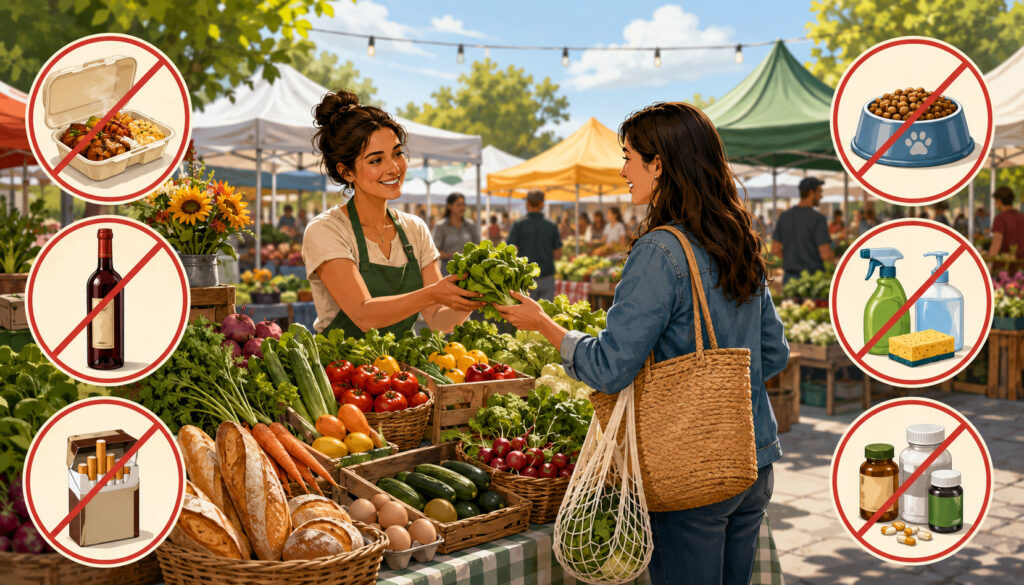
SNAP benefits cannot be used as a general-purpose payment method for everything available at a farmers market. Non-eligible categories commonly include:
- Alcoholic beverages.
- Cigarettes and tobacco products.
- Vitamins, medicines, and supplements.
- Food or drinks containing controlled substances.
- Hot foods at the point of sale.
- Pet food.
- Household supplies.
- Soaps and personal care items.
- Crafts, candles, and decorations.
- Decorative flowers and non-food-producing plants.
Items with a Supplement Facts label are generally treated as supplements rather than eligible foods. Vendors should inspect labels when selling herbal powders, concentrated products, wellness shots, or similar merchandise that may be classified differently from ordinary food.
Mixed booths require particular attention. A honey vendor may also sell candles, while a farm may sell vegetables, cut flowers, soap, and decorative wreaths. Staff must calculate the SNAP portion separately and collect another payment method for the remaining products.
A product should never be entered as an eligible food merely because the customer has enough benefits available or because the vendor lacks a separate checkout button.
Hot Prepared Foods and Ready-to-Eat Items
Foods sold hot at the point of sale are generally not eligible for ordinary SNAP purchases. This distinction is important for market vendors selling grilled meals, hot soup, warmed baked dishes, cooked meat, or other ready-to-eat products.
Prepared food eligibility can be complicated because temperature, packaging, intended use, and special program arrangements may matter. A refrigerated product intended for preparation at home may be treated differently from the same product heated and served for immediate consumption.
Vendors should not rely on informal assumptions such as “all food qualifies” or “anything packaged qualifies.” Employees should know which menu items are approved and how to separate qualifying cold products from non-eligible hot selections.
Special programs or disaster-related rules may create limited exceptions in some circumstances, but vendors should not apply an exception unless it clearly covers their operation and customer transaction.
Non-Food Market Products
Farmers markets frequently include merchandise beyond food. Crafts, pottery, kitchen accessories, clothing, candles, soap, lotions, jewelry, pet products, artwork, and decorative plants may contribute to the market experience but generally cannot be purchased with SNAP.
The same vendor may sell both qualifying food and non-food merchandise. For instance, a beekeeper might sell honey alongside beeswax candles, while a lavender farm may offer culinary products, soap, and decorative bundles.
Clear display organization reduces mistakes. Vendors can use shelf labels, product tags, or POS categories to separate eligible items without placing unnecessary attention on individual customers.
Market tokens should also be recognizable. Vendors need to know which tokens represent SNAP benefits and which represent credit card purchases, general market vouchers, promotional coupons, or nutrition incentives.
Accepting SNAP-funded tokens for non-food products and then submitting them for reimbursement creates a serious control problem. Market agreements should explain that vendors remain responsible for checking the purchase even when the customer’s card was processed centrally.
SNAP Requirements for Farmers Market Vendors Compared
The following table summarizes common requirement areas. It is a planning tool rather than a substitute for current program instructions.
| Requirement Area | What It Means | Why It Matters | What to Review |
| Authorization | Approval to accept SNAP EBT | Benefits should not be processed before approval | Applicant, location, ownership, and authorization status |
| Eligible foods | SNAP can pay only for approved products | Prevents improper transactions | Product list and current official guidance |
| Payment equipment | EBT terminal or approved processing setup | Enables authorized benefit transactions | Compatibility, connection, receipts, and reports |
| Token or scrip system | Market currency issued after an EBT transaction | Allows central processing across vendors | Issuance, denominations, security, and redemption |
| Recordkeeping | Transaction and reimbursement documentation | Supports reporting and reconciliation | Logs, receipts, redemption forms, and settlements |
| Vendor training | Staff understand SNAP procedures | Reduces checkout and token errors | Eligible foods, privacy, refunds, and customer flow |
| Signage | Instructions showing where SNAP is accepted | Helps customers navigate the market | Entrance, booth, and EBT station signs |
| Reconciliation | Comparison of transactions, tokens, and payouts | Identifies shortages and duplicate payments | Market-day closeout and settlement review |
A market may need additional controls for incentive programs, multiple locations, volunteers, equipment loans, or different token types.
How to Use the Table Before Accepting SNAP
Vendors and managers can turn each row into an implementation question. For example, instead of writing “equipment ready,” identify the terminal, authorized account, staff member, connectivity method, receipt process, and backup contact.
The table can also reveal gaps between the market and vendor procedures. A market may have authorization and equipment but no written token redemption schedule. A vendor may know which products qualify but not understand how refunds are handled.
Assign responsibility for every category. The authorization applicant should be identified, the product list should have an owner, and someone should be responsible for market-day reconciliation.
Review supporting documents rather than relying on verbal assurances. Confirm the authorization notice, processor instructions, vendor agreements, token logs, training materials, and settlement reports.
Complete a test run before publicly launching the program. Practice a transaction, token issuance, vendor purchase, token redemption, reimbursement calculation, and end-of-day closeout.
Why Requirements May Vary by Market Setup
A single farmer processing SNAP directly has a different workflow from a large market with fifty vendors and a central information booth.
In a vendor-level setup, the seller typically controls:
- The EBT device.
- Product entry.
- Customer transaction.
- Receipt.
- Refund.
- Settlement report.
- Daily reconciliation.
In a market-level system, responsibilities are divided. The market processes the benefit transaction and issues tokens, while vendors determine whether a product is eligible and later submit tokens for reimbursement.
Markets with nutrition incentives may have another layer of tracking. Incentive currency may have narrower product restrictions than ordinary SNAP-funded currency, such as use only for fruits and vegetables.
Location also matters. Connectivity, operating frequency, seasonal schedules, and local program partnerships can influence equipment and reporting procedures.
The market’s written guide should describe its actual operating model rather than copying generic procedures that do not match the customer journey.
How to Apply or Prepare for SNAP EBT Acceptance
Preparation should begin well before the first market date. Authorization, equipment delivery, account configuration, staff training, and testing can involve multiple steps.
A practical preparation process includes:
- Decide whether the market or individual vendor will process EBT.
- Review current retailer eligibility and authorization information.
- Identify the applicant and all relevant operating locations.
- Prepare requested business and ownership documentation.
- List the foods and other products offered.
- Apply through the official retailer process.
- Select compatible EBT payment equipment.
- Create eligible-product and non-eligible-product lists.
- Develop token procedures when central processing is used.
- Train everyone involved.
- Test transactions and reporting.
- Display signs only when acceptance is operational.
Applications should be complete and accurate. Inconsistent ownership information, incomplete documentation, or unclear product descriptions can delay review.
Authorization itself should not be confused with equipment activation. A vendor may receive approval but still need a properly configured terminal and transaction service before processing a customer’s card.
Information Vendors May Need to Prepare
Applicants should review the official application instructions for the exact documentation required. Depending on the applicant and operating arrangement, useful preparation may include:
- Legal business name.
- Ownership information.
- Tax identification information.
- Personal identification requested for responsible owners.
- Business and mailing addresses.
- Market or selling locations.
- Operating schedule.
- Contact details.
- Product and inventory information.
- Estimates or records related to food sales.
- Market agreements or participation details.
- Banking or settlement information requested during payment setup.
Information should be consistent across the application, business records, payment account, and market documents.
A seasonal farmer should explain the seasonal operating schedule accurately rather than entering a year-round schedule. A vendor serving multiple locations should disclose them as instructed and determine whether additional approvals are needed.
Keep copies of submitted documents and official communications. These records make it easier to answer questions, complete reauthorization, or update the account after an operational change.
Preparing Before the Market Season
Early preparation helps prevent an incomplete launch. Markets should work backward from opening day and set internal deadlines for authorization, equipment, vendor enrollment, signs, staff training, and testing.
Before the season begins:
- Confirm that authorization remains active.
- Verify every approved selling location.
- Update the participating vendor list.
- Review new product categories.
- Inspect and count reusable tokens.
- Test EBT terminals and printers.
- Replace weak batteries and charging cables.
- Confirm connectivity.
- Update staff permissions.
- Review refund procedures.
- Run a mock reconciliation.
New vendors should receive training before accepting any SNAP-funded token. Returning vendors should complete a refresher because products, employees, token designs, or program instructions may have changed.
Seasonal preparation is also the right time to review the broader farmers market payment processing workflow so that SNAP, debit, credit, cash, incentives, and general market vouchers are recorded separately.
EBT Equipment and POS Requirements for Farmers Markets
Authorized SNAP stores must use EBT equipment and transaction services to let shoppers pay for eligible foods. A farmers market therefore needs more than an ordinary cash register or generic card reader.
The selected setup should support the approved SNAP processing arrangement and provide controls appropriate for an outdoor, mobile environment.
Important features may include:
- EBT transaction support.
- Secure PIN entry.
- Portable operation.
- Rechargeable battery.
- Cellular or Wi-Fi connectivity.
- Transaction history.
- Receipts or transaction confirmation.
- User permissions.
- Refund and correction functions.
- Settlement reports.
- Reliable technical support.
A market should verify whether one device can process both SNAP and commercial card payments or whether separate terminals are required. Even when one device supports several payment types, reports should clearly distinguish them.
Equipment should be assigned to authorized personnel and stored securely between market dates. Passwords and access codes should not be shared broadly among vendors or volunteers.
EBT Terminals and Mobile POS Tools
An EBT terminal communicates with the benefit system, allows secure PIN entry, and records whether the transaction is approved or declined. At outdoor markets, the terminal may be located at a central booth or carried by an individual vendor.
A mobile POS for farmers markets can also support inventory, commercial card payments, receipts, and sales reporting. However, vendors must verify actual SNAP compatibility rather than relying on general debit-card capability.
Useful equipment questions include:
- Is SNAP EBT processing specifically supported?
- Is the terminal compatible with the vendor’s authorization?
- How is the customer PIN entered securely?
- Can a receipt or transaction record be produced?
- Are SNAP transactions separated from debit and credit sales?
- How are refunds initiated?
- Can reports be filtered by market date?
- What support is available during weekend hours?
The device should be easy to use without exposing customer balances or account details to people nearby. Screens should be positioned for privacy, and staff should never ask customers to say their PIN aloud.
Connectivity, Battery Life, and Backup Planning
Outdoor markets may have weak cellular service, crowded public Wi-Fi, rain, heat, limited power, or no fixed internet connection. These conditions should be tested at the actual market site.
A terminal that works at the office may lose service inside a covered pavilion or crowded downtown market. Test multiple carriers or approved connection methods where possible.
Markets should carry:
- Fully charged terminals.
- Approved charging cables.
- Portable power banks.
- Weather-resistant covers.
- Spare receipt paper.
- Contact information for technical support.
- Written outage procedures.
- Manual logs for operational notes.
Do not assume that an offline feature offered for ordinary card payments also permits offline SNAP transactions. Benefit availability and PIN verification may require real-time authorization. Confirm the correct procedure with the EBT provider.
If the device fails, staff should explain the situation respectfully and avoid inventing a workaround. Recording a card number manually, bypassing PIN controls, or promising to process benefits later may violate applicable procedures.
Market Tokens, Scrip, and Centralized SNAP Systems
Tokens and scrip allow a centrally authorized market to distribute SNAP purchasing power among multiple eligible vendors. The system can expand access without placing an EBT terminal at every booth.
A successful system needs controls for:
- Ordering or producing tokens.
- Secure token storage.
- Issuing market currency.
- Recording the EBT transaction.
- Identifying eligible vendors.
- Accepting tokens only for qualifying products.
- Collecting redeemed currency.
- Calculating vendor reimbursement.
- Handling unused customer currency.
- Reconciling the entire cycle.
The token should represent a specific funding source and denomination. SNAP-funded currency should not be confused with credit card tokens, promotional vouchers, or nutrition incentive currency.
Rules about change are especially important. Markets should follow the applicable program procedure rather than letting each vendor create a different policy.
The market should also define whether tokens expire, remain valid throughout the season, or can be used at future market dates.
How Token Systems Work
A typical token transaction begins when a customer requests a specific amount at the central booth. The market employee processes the EBT card and, after approval, issues an equal value of SNAP market currency.
The customer takes the tokens to participating vendors and selects eligible foods. The vendor verifies both the product and token type before accepting payment.
At the end of the market, or according to a regular schedule, vendors count their SNAP tokens and submit them with a redemption form. The market verifies the amount and reimburses the vendor.
The system should create a clear trail:
Approved EBT transaction → tokens issued → eligible vendor sale → tokens redeemed → vendor reimbursed.
Every stage should be documented. If the market processes a certain value in EBT transactions but cannot account for the corresponding tokens, staff should investigate before finalizing reports.
Customer instructions should be displayed near the EBT booth and explained without requiring shoppers to disclose unnecessary personal information.
Vendor Redemption and Reimbursement
Vendor reimbursement is one of the most important financial responsibilities in a centralized program. Sellers need to know when tokens are collected, how totals are verified, and when payment will be issued.
A redemption form may include:
- Vendor name or identification number.
- Market date.
- Number of tokens by denomination.
- Total redemption value.
- Incentive currency shown separately.
- Vendor signature.
- Staff verification.
- Reimbursement method.
- Payment date or reference.
Two people should verify large token counts when practical. The count should be compared with the submitted form before tokens are returned to circulation.
Markets should establish a predictable payment schedule. Delayed or inconsistent reimbursement can create cash-flow difficulties for small farms and may reduce vendor participation.
The market should never reimburse tokens that are invalid, from another program, improperly altered, or accepted for clearly non-eligible merchandise. Disputed submissions should be documented and reviewed under a written procedure.
Recordkeeping Requirements and Best Practices
Good recordkeeping connects customer transactions, market currency, vendor sales, settlement deposits, and reimbursements. It also helps managers find operational errors before they become recurring problems.
Useful records may include:
- EBT transaction reports.
- Terminal settlement reports.
- Token issuance logs.
- Token inventory records.
- Vendor redemption forms.
- Vendor reimbursement records.
- Refund and correction notes.
- Equipment service records.
- Staff and vendor training records.
- Participation agreements.
- Current eligible-product guidance.
- Customer service incident notes.
Records should be stored securely and made available only to people who need them. Documents should not display full account numbers, PINs, or unnecessary customer information.
Retention periods and required formats may depend on program instructions, contracts, grant conditions, or other applicable requirements. Markets should confirm how long specific records must be maintained.
Records Vendors Should Keep
Vendors participating in a central system should keep copies of redemption forms and reimbursement records. These documents help confirm that every submitted token was paid correctly.
A vendor file can include:
- Market participation agreement.
- SNAP training acknowledgement.
- Eligible-product list.
- Market token instructions.
- Daily token totals.
- Redemption form copies.
- Reimbursement confirmations.
- Notes about disputed or rejected tokens.
- Refund or exchange communications.
- Updated guidance from the market manager.
Direct-processing vendors should retain transaction and settlement reports from their EBT equipment along with ordinary sales records. SNAP sales should be identifiable without exposing protected customer information.
Product records can also be useful for mixed booths. A categorized inventory list shows which products employees were instructed to process as eligible, non-eligible, or requiring confirmation.
Vendors should compare reimbursement or settlement totals with their own sales records regularly rather than waiting until the end of the season.
Records Market Managers Should Keep
Market managers operating central EBT processing need a complete record of the transaction and token cycle.
For each market date, managers should be able to determine:
- Total approved EBT value.
- Total SNAP tokens issued.
- Total incentive currency issued.
- Tokens redeemed by each vendor.
- Tokens remaining in circulation.
- Vendor reimbursements owed.
- Vendor reimbursements completed.
- Refunds or transaction corrections.
- Unresolved differences.
The market should also maintain an equipment log recording the device assigned, operator, opening condition, closing condition, and any connectivity or settlement problems.
Training records should identify who received instruction and when. Updated materials should be distributed after a procedure changes.
A periodic management review can compare multiple market dates and look for unusual patterns, such as repeated token shortages, unusually high corrections, late vendor submissions, or reimbursement discrepancies.
Vendor Training for SNAP EBT Requirements
Training helps convert written rules into consistent market-day behavior. Every person accepting SNAP-funded tokens or processing EBT transactions should understand their role.
Training topics should include:
- What SNAP is used for.
- Who is authorized to process EBT.
- Eligible and non-eligible products.
- Handling mixed purchases.
- Token identification.
- Incentive currency differences.
- Secure PIN and device practices.
- Receipts and transaction confirmation.
- Refund and correction procedures.
- Customer privacy.
- Respectful communication.
- Escalation to the market manager.
Training should be practical rather than limited to distributing a document. Use sample products, mock tokens, checkout scenarios, and a practice reimbursement form.
Volunteers at a central booth need different training from individual vendors. Central staff should know how to operate the terminal and issue currency, while booth staff should focus on product eligibility and token acceptance.
Refresher training should occur before a new season, after staffing changes, and whenever program procedures are updated.
Training Staff on Eligible and Non-Eligible Items
Every employee should be able to identify the main qualifying food categories and the most common non-eligible products sold at that specific booth.
Training should use the vendor’s real inventory. A generic list may not address questions involving herbal products, decorative plants, hot baked goods, meal kits, supplements, candles, or mixed gift baskets.
A helpful exercise is to place sample products into three groups:
- Accept with SNAP.
- Do not accept with SNAP.
- Ask a supervisor before processing.
Staff should also know how to split a mixed transaction. The customer may use SNAP for qualifying food and another payment method for crafts, hot food, or household products.
Employees should never change a product description simply to make the transaction go through. When uncertainty remains, they should ask the designated manager and consult official guidance.
Training Staff on Customer Communication
Customers should receive the same courteous service regardless of payment method. Staff should explain the process without drawing unnecessary attention to the customer or making assumptions about eligibility.
Useful explanations include:
- Where the central EBT station is located.
- Which token can be used at the booth.
- Which products qualify.
- How to pay for a mixed purchase.
- Where to ask about unused tokens.
- Who can help with a transaction problem.
Employees should not ask why a customer receives benefits or request personal information unrelated to the transaction. They should never ask the customer to reveal a PIN.
When an item is not eligible, staff can state that the product cannot be paid for with that token and offer another payment option. Avoid judgmental comments about what customers should or should not purchase.
Respectful communication supports food access and helps the market remain welcoming to the entire community.
Signage and Customer Education Requirements
Clear signs help customers understand whether SNAP is accepted, where to process an EBT card, which vendors participate, and how market currency works.
Signs can address:
- SNAP acceptance.
- Location of the EBT booth.
- Market operating hours.
- Token denominations.
- Participating vendor identification.
- Eligible purchase categories.
- Nutrition incentive availability.
- Procedures for unused tokens.
- Contact point for transaction questions.
Signs should be readable from a reasonable distance and placed along the customer’s natural path through the market. Instructions should be consistent with the procedures taught to employees.
Do not advertise acceptance until authorization, equipment, and staffing are ready. A sign that sends customers to a closed or nonfunctioning EBT booth damages trust.
Markets should review signs when token designs, booth locations, hours, vendors, or procedures change.
Clear Market-Level Signage
Place market-level signs near entrances, parking approaches, information areas, and the EBT station. Directional arrows can help customers locate a booth that is not visible from the entrance.
The central sign should explain the customer flow in a few steps:
- Bring the EBT card to the market station.
- Choose the amount to process.
- Enter the PIN securely.
- Receive market currency.
- Spend it with eligible participating vendors.
Where an incentive program is available, explain how it relates to the SNAP transaction and which products may be purchased with the incentive currency.
Market-level signs should not contain outdated limits, expired promotions, or instructions that differ from staff training.
Contact information can be provided for questions that cannot be resolved during the market, but signs should not ask customers to display account details publicly.
Vendor Booth Signage
Booth signs help shoppers identify participating vendors without repeatedly asking whether tokens are accepted.
A vendor sign may indicate:
- SNAP market currency accepted here.
- Eligible products available.
- Incentive currency accepted for approved produce.
- Other payment methods accepted.
- Where mixed purchases are separated.
Booth-level signage should not imply that every product on display qualifies. Vendors selling mixed merchandise may use shelf labels or separate display areas to distinguish eligible foods.
Signs should match the token system. If the market uses several forms of currency, vendors should show only the types they are authorized to accept.
A well-designed sign can also shorten checkout time. Customers can organize tokens and other payment methods before reaching the front of the line, reducing confusion during busy hours.
Refunds, Exchanges, and Transaction Corrections
Refunds involving SNAP funds or market currency should follow an approved procedure. Vendors should not improvise by handing customers cash for an EBT-funded purchase.
Situations requiring a procedure may include:
- An incorrect EBT amount.
- A duplicate transaction.
- A declined transaction that appears completed.
- A damaged eligible product.
- An exchange for another product.
- Unused market tokens.
- A vendor accepting the wrong token type.
- A customer disputing a purchase amount.
The appropriate response may differ depending on whether the vendor or market processed the original EBT transaction. In a centralized program, vendors should usually refer benefit-account adjustments and token-return questions to the market’s authorized station.
Every correction should be documented with the market date, amount, reason, employee, and action taken. Documentation should avoid unnecessary customer account information.
Handling Customer Questions About SNAP Purchases
Staff should listen carefully and identify whether the question concerns product eligibility, token use, benefit balance, refund procedure, or a possible terminal error.
Questions about a customer’s benefit account may need to be directed to the number or resource provided by the issuing program. Vendors should not speculate about why a balance changed or why a transaction was declined.
For market-token questions, staff can explain where the token was issued and who is authorized to review the transaction. A customer should not be sent from booth to booth without clear direction.
When the vendor made an error, staff should acknowledge it and involve the market manager promptly. Avoid promising cash or another remedy before confirming the approved procedure.
A written customer-service script can help seasonal employees respond calmly while protecting privacy.
Avoiding Improper Refund Practices
Cash should not be provided in exchange for SNAP benefits or SNAP-funded market currency. Vendors should also avoid giving cash change from benefit-funded tokens unless an applicable approved procedure specifically permits it.
Improper practices may include:
- Refunding an EBT-funded purchase in cash.
- Buying tokens from customers.
- Exchanging tokens for non-food items.
- Creating a false sale to remove benefits.
- Processing a higher amount and returning the difference.
- Reimbursing a vendor for unsupported token totals.
Markets should document how unused tokens, returned food, duplicate transactions, and equipment errors are handled. The authorized entity and payment provider should confirm the procedure.
When an unusual situation is not covered, pause and seek guidance rather than creating a convenient but unapproved solution.
Common SNAP Compliance Mistakes to Avoid
Many operational mistakes begin with unclear responsibilities. Vendors may believe the market handles eligibility, while the market assumes every vendor has trained its employees.
Common errors include:
- Accepting benefits before authorization.
- Using a terminal not configured for SNAP.
- Processing non-eligible items.
- Allowing unauthorized staff to access equipment.
- Failing to separate mixed purchases.
- Accepting the wrong token.
- Giving improper cash refunds or change.
- Losing token issuance records.
- Reimbursing vendors without verification.
- Failing to reconcile reports.
- Displaying inaccurate signs.
- Ignoring changes in products or locations.
A single error should be corrected, documented, and used as a training opportunity. Repeated errors may indicate that the procedure, POS configuration, or supervisory review needs improvement.
Managers should create a clear escalation path so that employees can ask questions without feeling pressured to complete a questionable transaction.
Accepting SNAP for Non-Eligible Items
Mixed-product booths face the greatest risk of incorrect sales. Product separation should begin before checkout through inventory categories, shelf labels, and staff training.
The POS system should not place every item under a general “market goods” or “food” button. Create individual categories for eligible food, hot prepared food, non-food merchandise, decorative plants, and supplements.
Gift baskets require special attention because they may contain eligible food alongside non-food items. Vendors should verify how such products are treated before accepting benefits.
When customers purchase both eligible and non-eligible products, calculate the eligible subtotal first. Complete the SNAP transaction for that amount and collect another method for the balance.
Consistent separation protects both the customer’s benefits and the vendor’s authorization.
Poor Token or Scrip Tracking
Token discrepancies can occur when staff issue the wrong amount, vendors accept another market’s currency, or managers reimburse a handwritten estimate instead of a verified count.
Poor tracking can lead to:
- Overpayment or underpayment of vendors.
- Unexplained differences between EBT sales and tokens.
- Duplicate reimbursement.
- Missing market currency.
- Disputes between vendors and managers.
- Inaccurate grant or incentive reports.
Use pre-numbered forms, controlled token storage, clear denominations, and separate containers for different funding sources. Count the opening and closing token inventory at the EBT booth.
Redeemed tokens should be marked, bagged, or recorded in a way that prevents them from being submitted twice before recirculation.
Best Practices for Meeting USDA SNAP Requirements
A strong SNAP operation combines authorization, technology, training, customer service, and accounting.
Recommended practices include:
- Review official guidance before accepting EBT.
- Confirm who holds the authorization.
- Verify all approved locations.
- Identify eligible and non-eligible products.
- Train staff and participating vendors.
- Display accurate signs.
- Test the terminal before market day.
- Maintain backup power.
- Create a written token process.
- Separate SNAP and incentive currency.
- Track issued and redeemed tokens.
- Document refunds and corrections.
- Reconcile after every market.
- Protect customer privacy.
- Keep current support contacts available.
- Review procedures after operational changes.
The market manager should not be the only person who understands the system. At least one trained backup should be available when the primary operator is absent.
Technology can support these controls, but it cannot replace them. A reliable farmers market POS system should make payment categories and reports easier to manage, while employees remain responsible for correct product classification and transaction handling.
Creating a Written SNAP Procedure
A written guide should reflect the market’s actual customer and vendor workflow.
Include:
- Authorization holder and responsible contacts.
- Approved operating locations.
- Opening equipment checks.
- EBT transaction steps.
- Token issuance procedure.
- Eligible-product rules.
- Vendor acceptance rules.
- Incentive currency procedure.
- Refund and correction steps.
- Vendor redemption process.
- Reimbursement schedule.
- Daily reconciliation.
- Record storage.
- Incident reporting.
- Equipment failure procedure.
Use checklists, screenshots, sample tokens, and completed example forms where helpful. Keep the guide at the EBT booth and provide the relevant sections to vendors.
The procedure should identify actions that are prohibited, including cash exchanges, PIN handling, and acceptance of tokens for non-eligible products.
Reviewing Requirements Regularly
Retail requirements, product rules, state waivers, equipment, and market operations may change. A procedure written several seasons ago should not be assumed to remain complete.
Review the program:
- Before each market season.
- Before reauthorization.
- After adding a location.
- After changing ownership.
- When replacing EBT equipment.
- When adding new vendors.
- When introducing an incentive program.
- After a significant transaction error.
- When official guidance changes.
The official retailer eligibility page currently warns that some posted content is being updated due to revised stocking standards. This illustrates why farmers market vendors should verify current instructions instead of relying solely on old training materials.
Document the review date and distribute revisions to staff and vendors.
USDA SNAP Requirements Checklist for Farmers Market Vendors
The following checklist can support preparation and routine market-day reviews.
| Checklist Area | What to Check | Why It Matters |
| Authorization | Confirm SNAP approval status and authorized entity | Approval is needed before processing benefits |
| Eligible foods | Review the current product list | Prevents improper purchases |
| Non-eligible items | Separate products clearly | Reduces checkout errors |
| EBT equipment | Test terminal, PIN entry, connection, and battery | Keeps transactions moving |
| Signage | Display accurate directions and acceptance signs | Helps customers shop confidently |
| Training | Educate employees, volunteers, and vendors | Creates consistent procedures |
| Token system | Track issued and redeemed currency | Supports accurate vendor payouts |
| Receipts | Provide or retain appropriate transaction proof | Assists customer service and reporting |
| Reconciliation | Compare transactions, tokens, and reimbursements | Detects shortages and duplicate payments |
| Records | Organize logs, settlements, and correction notes | Supports responsible operations |
The checklist should be adapted to the market’s setup. Direct-processing vendors may not need token controls, while centralized markets will need detailed vendor redemption procedures.
How to Use the Checklist Before Market Day
Assign each checklist area to a specific person. “Staff will check equipment” is less effective than naming the opening booth operator or market manager.
Before opening:
- Confirm the authorization and equipment are active.
- Count the starting token inventory.
- Test the terminal connection.
- Check paper, battery, and chargers.
- Verify signs and vendor participation.
- Confirm trained staff coverage.
- Review support contacts.
- Inspect separate containers for SNAP and incentive currency.
Vendors should inspect their displays and remove outdated SNAP labels. New products should be classified before the first customer transaction.
At closing, use the same checklist in reverse: close the terminal, save reports, count tokens, collect vendor forms, note incidents, and secure equipment.
Documentation to Keep After Each Market
A complete market-day file may contain:
- EBT transaction summary.
- Settlement report.
- Opening and closing token counts.
- Token issuance log.
- Vendor redemption sheets.
- Vendor reimbursement totals.
- Incentive program report.
- Refund or correction notes.
- Device failure notes.
- Staff schedule.
- Customer service incidents.
- Unresolved reconciliation differences.
Records should be reviewed promptly while employees still remember what happened. A discrepancy found several weeks later is much harder to investigate.
Managers should sign or approve the final reconciliation and document how differences were resolved. Unresolved amounts should remain visible rather than being removed from the report to make totals match.
How to Choose Farmers Market POS Systems for SNAP EBT Requirements
Payment technology should be selected around the market’s authorized operating model, not merely the lowest hardware price.
A suitable system may need to support:
- SNAP EBT transactions.
- Secure PIN entry.
- Debit and credit card payments.
- Mobile operation.
- Product categories.
- Printed or digital receipts.
- Transaction history.
- Refund controls.
- Staff permissions.
- Multiple market locations.
- Settlement reporting.
- Vendor reimbursement reporting.
- Reliable battery performance.
- Cellular or Wi-Fi connections.
- Technical support.
A POS may be excellent for commercial cards but unsuitable for SNAP EBT. Obtain written confirmation of compatibility and understand who is responsible for activation, certification, settlement, and support.
Markets using tokens should also decide whether the POS will track only the initial EBT transaction or the entire token and vendor reimbursement cycle. Some markets use separate logs or accounting tools for redemption.
Questions to Ask Before Choosing EBT Payment Tools
Ask prospective providers or program administrators:
- Does the system specifically support SNAP EBT?
- Is it compatible with the market’s authorization?
- How is secure PIN entry handled?
- Can SNAP and cash-benefit transactions be distinguished?
- How are eligible and non-eligible items separated?
- Are customer receipts available?
- How are refunds and reversals processed?
- Can reports be filtered by market date and location?
- Does the device require continuous internet service?
- What happens during a connection failure?
- How long does the battery last?
- Are user permissions available?
- Can managers review transaction history remotely?
- How are settlement totals accessed?
- What fees apply?
- Is weekend support available?
- How are software and security updates delivered?
Do not accept a vague statement that a device is “EBT ready.” Confirm the exact functions required for the market’s program.
Comparing Reliability, Simplicity, and Reporting
Equipment cost is only one part of the decision. A low-cost device that loses connectivity, produces unclear reports, or is difficult for volunteers to operate may create greater administrative costs.
Reliability matters because a failed EBT station can prevent customers from purchasing food and reduce vendor sales. Simplicity matters because market staff may change from week to week.
Reporting is equally important. Managers need to compare electronic transactions with token issuance, redemptions, and vendor reimbursement. Reports should make this process easier rather than requiring estimates.
Evaluate the full customer journey and conduct an onsite test. The best system is one that processes authorized transactions securely, works in the market environment, supports accurate records, and can be operated consistently by trained staff.
Frequently Asked Questions
What are USDA SNAP requirements for farmers market vendors?
USDA SNAP requirements for farmers market vendors include obtaining proper authorization, selling only SNAP eligible foods through benefit transactions, using approved EBT processing tools, training employees, protecting customer information, and maintaining accurate records.
Additional requirements may apply when a market uses tokens, scrip, nutrition incentives, or centralized payment processing. Vendors should review current official program guidance because the exact responsibilities depend on who holds the authorization and how transactions are managed.
Do farmers market vendors need authorization to accept SNAP?
A vendor generally needs authorization when processing SNAP benefits directly through its own EBT equipment. Selling at an approved farmers market does not automatically authorize every vendor to process EBT cards independently.
When the market organization is authorized and operates a central token system, participating vendors may accept approved market currency under the market’s procedures. They should not use the market’s authorization to process direct EBT transactions elsewhere unless separately approved.
What foods can farmers market vendors sell with SNAP EBT?
Qualifying products generally include foods intended for household consumption, such as fruits, vegetables, meat, poultry, fish, dairy products, eggs, bread, cereals, packaged foods, and nonalcoholic beverages.
Seeds and plants that produce food for the household may also qualify. Vendors should check current official guidance and any applicable state-level instructions before processing uncertain products.
What items are not eligible for SNAP at farmers markets?
Common non-eligible products include alcohol, tobacco, vitamins, medicines, supplements, hot food at the point of sale, pet food, household supplies, soap, candles, crafts, and decorative plants.
Mixed-product vendors should separate these products from eligible foods during checkout. Another payment method should be used for the non-eligible portion of the purchase.
How do EBT token systems work at farmers markets?
A customer processes an EBT card at a central market station and receives tokens or scrip equal to the approved transaction amount. The customer then spends that currency with participating vendors on eligible foods.
Vendors submit redeemed tokens to the market, and the market reimburses them. The market must reconcile the EBT total, currency issued, vendor redemptions, and reimbursements.
What records should farmers market vendors keep for SNAP transactions?
Vendors should keep relevant sales records, token redemption forms, reimbursement confirmations, eligible-product instructions, refund notes, and communications from the market or program administrator.
Direct-processing vendors should also retain terminal transaction and settlement reports. Records should never include customer PINs or unnecessary sensitive account information.
What equipment is needed to accept SNAP EBT at farmers markets?
The authorized entity needs an EBT processing arrangement with equipment capable of securely completing applicable SNAP transactions. This may involve a dedicated terminal or a compatible POS and mobile terminal.
Markets should review battery life, connectivity, secure PIN entry, receipts, reporting, refunds, user access, and support. An ordinary credit card reader should not be assumed to support SNAP.
How can market managers train vendors on SNAP EBT requirements?
Managers can provide a written vendor guide, product examples, token samples, checkout scenarios, refund instructions, and a mock redemption form.
Training should explain eligible foods, non-eligible merchandise, token types, incentive currency, customer communication, privacy, reimbursement, and escalation procedures. Refresher instruction should be provided when vendors, products, equipment, or official guidance change.
Conclusion
Understanding USDA SNAP requirements for farmers market vendors is essential for responsible benefit acceptance and smooth market operations. Authorization, product eligibility, payment equipment, token controls, recordkeeping, and employee training work together as one operating system.
Vendors and market managers should first determine who will hold SNAP market authorization and who will process the customer’s EBT card. They should then identify eligible and non-eligible products, select compatible equipment, and build procedures around the actual customer and vendor workflow.
Markets using tokens or scrip need especially strong controls. Every approved EBT transaction should connect clearly to market currency issued, eligible food purchased, tokens redeemed, and vendor reimbursement completed.
Clear signs and respectful communication make SNAP EBT at farmers markets easier for customers to use. Accurate reports and prompt reconciliation help protect vendors from missing or incorrect payments.
Because retailer standards, product restrictions, and operating guidance can change, vendors should review official SNAP retailer resources regularly and contact the appropriate program administrator when a requirement is unclear.
A well-managed program supports more than farmers market payment processing. It strengthens food access, builds customer confidence, improves vendor reimbursement, and helps community markets serve shoppers consistently and responsibly.