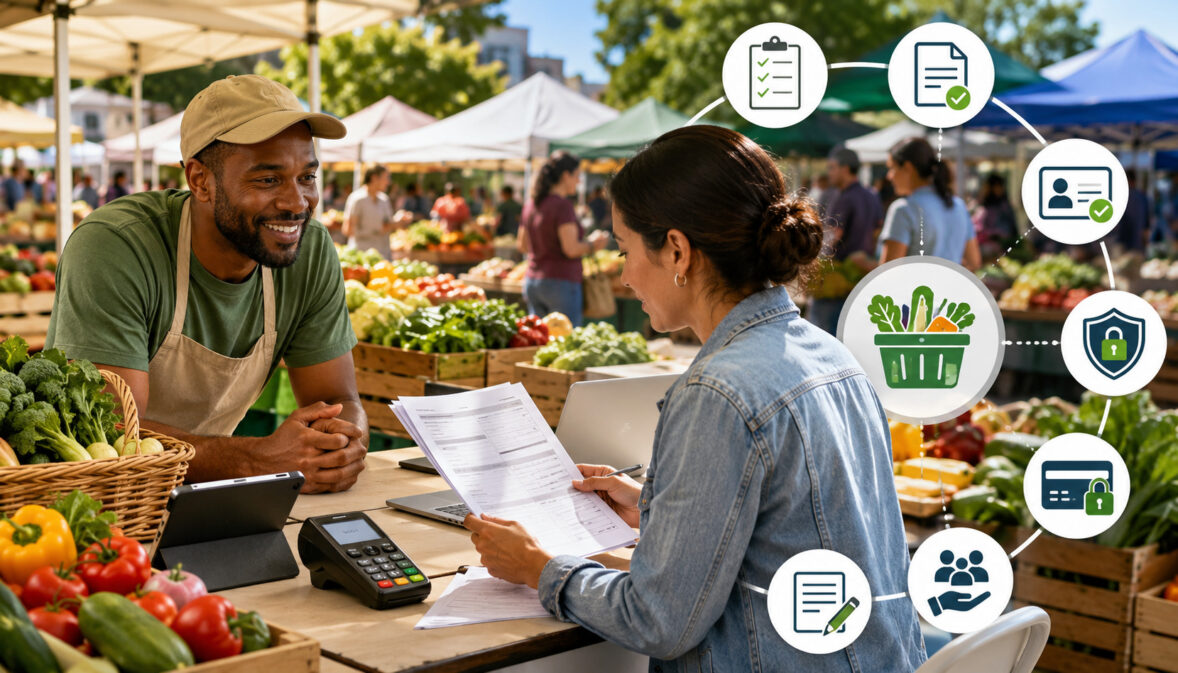
Learning how to apply for SNAP acceptance at farmers markets can help market organizations, local growers, food producers, and community organizers make nutritious food available to more shoppers. It can also create a more inclusive market environment for households that use food assistance benefits to purchase groceries.
SNAP purchases are completed through electronic benefits transfer, commonly called EBT. Customers receive benefits on an EBT card and use those funds to purchase qualifying food from an authorized retailer.
At a farmers market, transactions may be processed at a central information booth, directly at an approved vendor’s stall, or through a combination of both approaches.
Accepting SNAP is not the same as simply adding another card option to a payment terminal. A market or vendor generally must receive authorization before processing benefits.
The applicant must also understand SNAP eligible foods, establish an approved transaction method, train participating vendors, communicate the process to customers, and maintain organized transaction records.
The correct setup depends on how the farmers market operates. A market organization may manage transactions centrally and issue tokens or paper scrip that customers spend with approved vendors.
Alternatively, eligible vendors may complete their own SNAP application for farmers market vendors and process purchases directly at their booths.
Reliable payment technology is only one part of the process. Successful SNAP EBT at farmers markets also depends on clear signs, trained staff, accurate vendor reimbursement procedures, responsible refund handling, secure payment practices, and consistent reconciliation after each market day.
Because application standards and operating rules can change, applicants should review official SNAP retailer guidance before submitting information or purchasing equipment. Markets should also confirm any applicable state or local program instructions. This article provides general educational guidance and should not be treated as legal or regulatory advice.
What Does SNAP Acceptance at Farmers Markets Mean?
SNAP acceptance at farmers markets means an authorized market or eligible vendor can receive food assistance benefits as payment for approved food items. A customer presents an EBT card, enters a personal identification number when required, and authorizes a purchase from the available benefit balance.
The way the purchase is completed may differ from one market to another. Some markets have a central EBT station where the customer chooses an amount to debit from the card. The market then gives the customer tokens, paper scrip, or another approved form of market currency with an equal value.
The shopper uses that market currency with participating vendors that sell qualifying foods. Vendors later return the collected tokens or scrip to the market manager for reimbursement.
Other markets allow individually authorized vendors to process EBT cards directly. In that arrangement, each participating vendor generally maintains responsibility for the transaction equipment, eligible-item controls, reports, and operational compliance connected to the vendor’s authorization.
A hybrid market may use a central system for some sellers while individually authorized vendors process their own transactions. Although this approach can provide flexibility, it requires especially clear instructions so customers and vendors understand which booths accept market tokens, which process EBT cards directly, and which products are eligible.
The official farmer and producer guidance explains that authorized retailers must use EBT equipment and transaction services to process qualifying purchases. It also recognizes central scrip systems and smartphone- or tablet-based options for appropriate farmers market operations.
SNAP Acceptance vs Regular Card Payments
A SNAP EBT transaction can resemble a debit card transaction at checkout, but the rules governing the purchase are different. Credit and debit cards can generally be used for any lawful product the merchant sells. SNAP funds can only be used for qualifying food items under applicable program rules.
This difference means a farmers market POS system must do more than transmit a payment. Staff need a reliable way to separate eligible food from non-eligible merchandise. If a customer purchases vegetables, soap, a decorative item, and a hot prepared meal at the same booth, the SNAP portion must be limited to products that qualify.
Regular payment processing is based primarily on the transaction amount and card authorization. SNAP payment processing also involves retailer authorization, eligible-product controls, benefit-specific refund rules, transaction records, and restrictions on exchanging benefits for cash.
A regular card transaction may result in a cash refund under the seller’s standard policy. A SNAP purchase generally requires a compliant benefit-account credit or another approved procedure rather than cash. Markets should confirm the proper process with their transaction provider and official program administrator before handling refunds.
Central market currency creates another distinction. A debit card token and a SNAP token may look similar but should be clearly distinguishable. Different colors, markings, shapes, or denominations can reduce accidental use for products that do not qualify.
Markets evaluating both EBT and ordinary card acceptance can review practical considerations for contactless and mobile payment tools at farmers markets. However, support for credit or contactless payments does not automatically mean a terminal can process SNAP EBT.
Why Authorization Is Required Before Accepting SNAP
Selling fruits, vegetables, bread, meat, eggs, or other staple foods does not automatically make a business a SNAP authorized farmers market or retailer. Authorization is a separate approval process through the appropriate official retailer channel.
The review helps determine whether the applicant and operation meet program requirements. Depending on the applicant type, the review may consider the business structure, ownership or responsible-party information, products sold, operating locations, market schedule, vendor relationships, and other supporting information.
The official retailer service center identifies the retailer application as Form FNS-252 and advises applicants to provide complete, accurate, signed, and dated information. Missing or inconsistent information can delay review.
Authorization also establishes who is responsible for the SNAP activity. With market-level authorization, the market organization generally operates the central terminal and manages market currency, vendor agreements, redemption, reimbursement, and reconciliation.
With vendor authorization, the approved vendor processes transactions and maintains the required operational controls. A vendor should not use another business’s authorization number, terminal credentials, or settlement arrangement unless an officially approved structure permits it.
Applicants should wait for formal approval before advertising that they accept SNAP or attempting live transactions. Equipment compatibility, payment contracts, and training can be researched in advance, but benefits should only be processed after authorization and activation requirements have been completed.
Who Can Apply for SNAP Acceptance at Farmers Markets?

The appropriate applicant depends on the market’s legal and operating structure. A farmers market organization may apply to operate a centralized SNAP system for participating vendors. In other situations, an individual farmer, producer, farm stand, produce seller, or qualifying food vendor may apply independently.
Farmers markets and qualifying direct marketing farmers can generally seek authorization when they meet the applicable eligibility standards. However, an applicant should not assume that every vendor category qualifies merely because the business participates in a farmers market.
The products offered matter. A farm selling fresh produce, eggs, dairy foods, meat, poultry, fish, bread, or food-producing seeds and plants may be a stronger fit than a booth selling only crafts, flowers intended for decoration, household products, or hot ready-to-eat meals.
A market organization should evaluate whether it has the staff and administrative capacity to operate a central system. Market-level acceptance can make SNAP shopping available across multiple eligible booths, but the manager must oversee tokens, vendor reimbursement, equipment, signs, training, daily records, and reconciliation.
Individual vendor authorization can reduce the central market’s administrative burden. However, it may produce an uneven customer experience if only a few booths can process EBT cards or if vendors use different devices and procedures.
Community market organizers should document who owns the market, who controls operations, who will serve as the responsible party, and who will receive settlement funds. Informal groups may need to clarify their organizational structure before completing a farmers market SNAP application.
Market-Level SNAP Authorization
Market-level SNAP authorization is commonly used by multi-vendor markets that want to provide one centralized access point. The market organization applies as the retailer and, after approval, operates an EBT terminal at an information table or designated booth.
A customer visits the central station and requests a benefit transaction. After the card transaction is approved, the market gives the shopper tokens, paper scrip, receipts, or other permitted market currency representing the approved amount.
The shopper can then visit participating vendors and purchase SNAP eligible foods. Vendors accept the designated market currency only for qualifying items and return it to the market according to the agreed redemption schedule.
The market reimburses vendors based on verified redemption totals. This requires a reliable process for counting market currency, documenting vendor submissions, comparing tokens issued with tokens redeemed, reviewing settlement reports, and identifying discrepancies.
The central model can improve access because a customer completes the card transaction once and then shops across the market. It can also allow eligible vendors to participate without each vendor operating an individual EBT terminal, provided the arrangement follows the market’s authorization and applicable requirements.
The official scrip-system guidance describes a centralized POS model in which the market processes the EBT transaction and issues its own currency for use with participating sellers.
Individual Vendor SNAP Authorization
Individual vendor authorization allows an eligible seller to process SNAP EBT directly at the booth. This setup may be practical for a farm that attends several markets, operates a roadside stand, or sells regularly from a mobile location.
The vendor generally applies under its own business identity and provides information about ownership, products, locations, and operations. After approval, the vendor arranges compatible EBT payment processing for farmers markets and trains employees who will use the equipment.
Direct acceptance can make checkout straightforward. The customer chooses eligible items, the vendor enters the qualifying purchase amount, and the EBT card is processed at the booth without first visiting a market information station.
This setup also gives the vendor direct access to transaction reports and settlement information. The vendor can reconcile EBT sales with its own inventory and daily sales records instead of waiting for token reimbursement from the market.
However, the vendor assumes more responsibility. It must prevent non-eligible purchases, protect customer information, maintain equipment, handle receipts and refunds properly, monitor settlement activity, and retain relevant records.
A SNAP vendor application may make sense when the seller has consistent eligible-food inventory and enough transaction volume to justify separate equipment and administration. Vendors should still coordinate with market management so signs, customer directions, and market communications remain consistent.
Step-by-Step Overview: How to Apply for SNAP Acceptance at Farmers Markets
The exact process may vary according to the applicant and operating model, but the following sequence provides a practical overview of how to apply for SNAP acceptance at farmers markets.
- Review official retailer eligibility guidance: Learn what types of operations and products may qualify before creating an account or submitting an application.
- Choose the applicant structure: Decide whether the market organization will apply, individual vendors will apply, or a carefully managed hybrid model will be used.
- Identify eligible and non-eligible products: Review every major product category sold by participating vendors.
- Gather market and business information: Collect legal names, addresses, contact details, market schedules, operating locations, and organizational records.
- Prepare responsible-party information: Determine which owners, officers, managers, or other responsible individuals must provide information.
- Prepare vendor information: A central market may need an accurate list of participating sellers and the categories of products they offer.
- Complete the official SNAP EBT application: Use the approved retailer application channel and enter information carefully.
- Upload or submit supporting documentation: Provide requested identity, business, ownership, location, or operating records.
- Monitor application communications: Respond promptly to requests for clarification or additional documents.
- Wait for formal authorization: Do not process SNAP benefits before approval.
- Select compatible EBT equipment:. Confirm that the terminal, processor, and settlement setup support authorized SNAP transactions.
- Create operating procedures: Document transaction steps, token rules, eligible-product controls, refunds, reimbursement, security, and reconciliation.
- Train staff and vendors: Practice customer transactions and market currency procedures before launch.
- Install signs and customer instructions: Explain where EBT transactions occur and which vendors participate.
- Test equipment and reports: Verify charging, connectivity, receipts, user access, settlement reporting, and support contacts.
The authorization process itself is generally free, although equipment, wireless service, payment processing, market currency, staffing, and administrative support may involve costs.
Why Preparation Before Applying Matters
Preparing before submission helps the applicant provide consistent answers. A market that has not decided whether it will operate centrally or rely on individual vendors may enter information that does not match its intended operations.
Start by documenting the market structure. Identify the organization that controls the market, the person responsible for the application, the bank account intended for settlement where applicable, and the staff member who will supervise SNAP operations.
Create a vendor inventory that separates sellers of qualifying foods from sellers of non-food products. For mixed-product booths, list the eligible and non-eligible categories separately.
Applicants should also review market schedules and locations. Seasonal markets, rotating community markets, and mobile operations may need to explain where and when sales occur.
Preparing an equipment concept is equally important. The applicant does not necessarily need to purchase a terminal before approval, but it should understand whether transactions will be processed centrally, directly at booths, or through a mobile POS for farmers markets.
Finally, estimate the administrative workload. A token system may require multiple staff members during busy hours, secure token storage, counting procedures, vendor redemption forms, and a reimbursement schedule.
What Happens After Submission
After the SNAP EBT application is submitted, the reviewing office may examine whether the applicant is eligible and whether the information is complete. The review may include the applicant’s business identity, ownership, responsible parties, products, operating model, and market locations.
The applicant may receive a request for additional documentation or clarification. A prompt, complete response can help prevent avoidable delays.
Market managers should monitor the email address, online account, mailing address, and telephone number used in the application. Follow-up messages can be missed when a seasonal employee submits the application using a temporary account.
Applicants should avoid making changes to ownership, settlement information, or the proposed operating structure without keeping records and determining whether the reviewing authority must be notified. Material changes can affect the accuracy of the application.
Approval does not automatically configure the payment equipment. The applicant may still need to arrange an EBT terminal, establish processing services, connect the authorization information to the equipment, and complete test or activation procedures.
A denial, request for more information, or delayed decision should be handled through the instructions provided in the official communication. Applicants should not submit duplicate applications unless directed to do so.
Information You May Need for a Farmers Market SNAP Application
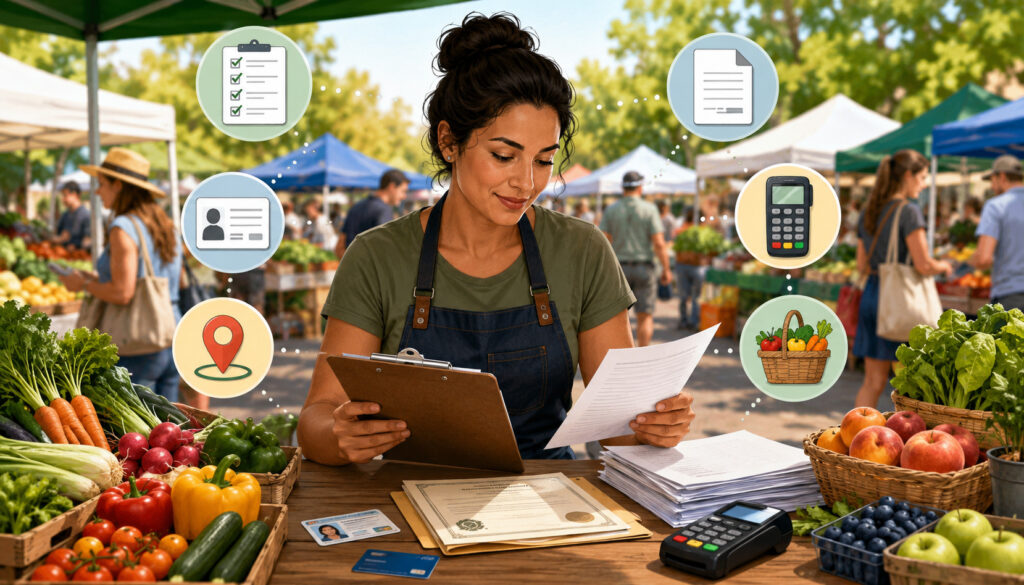
A farmers market SNAP application may request enough information to identify the applicant, evaluate the retail operation, and determine who is responsible for SNAP activity. The exact request can vary, so applicants should rely on the current official application instructions.
Common information may include:
- Market or business legal name
- Trade name or public market name
- Physical and mailing addresses
- Telephone number and email address
- Business structure
- Ownership or responsible-party information
- Tax identification details where required
- Market locations and operating schedules
- Product categories
- Eligible food items sold
- Approximate sales information where requested
- Vendor list for a centrally operated market
- Bank or settlement information where applicable
- Identity or business documentation
- Proposed EBT equipment arrangement
- Supporting records requested during review
Names and addresses should match supporting records. Applicants should distinguish between the legal entity, public-facing market name, mailing address, market site, and seasonal operating location.
Markets operating at multiple locations should not assume one application automatically covers every site or operating model. They should explain their arrangement accurately and request guidance when uncertain.
Applicants should also protect sensitive information. Ownership documents, identification records, and financial details should be submitted only through approved channels rather than ordinary email unless specifically instructed.
Business and Market Details
Accurate business information helps the reviewer determine who is applying and who will be accountable for the authorized operation. A small difference—such as using a market nickname instead of the registered entity name—can create confusion when documents are compared.
The physical address should describe the actual operating location where possible. A seasonal market may operate in a public square, school parking lot, community center, or other temporary site, while receiving mail at a separate office.
Applicants should clearly identify both addresses rather than treating them as interchangeable. The same care should be used for telephone numbers and email addresses.
A market schedule can help explain whether the operation is weekly, daily, seasonal, mobile, or event-based. Include consistent opening periods and locations when the application requests them.
The business structure may also affect which people must provide information. A nonprofit organization, cooperative, limited liability entity, sole proprietor, partnership, or municipal market may have different responsible parties.
Before submitting, compare the application against formation documents, tax records, leases, permits, vendor agreements, and bank information where relevant. Do not guess when an item is unclear; request official assistance.
Product and Eligible Food Information
Product information is central to the review because SNAP authorization is tied to qualifying food sales. A market should not provide a vague answer such as “farm goods” when its vendors sell a wide variety of food and non-food products.
Create categories that reflect what shoppers can actually purchase. These might include fresh fruits, vegetables, herbs, eggs, bread, grains, meat, poultry, fish, dairy foods, preserves, packaged snacks, nonalcoholic beverages, seeds, and food-producing plants.
Separately identify crafts, clothing, soap, candles, decorative flowers, alcohol, supplements, hot meals, pet products, and household goods. Mixed markets should demonstrate that SNAP transactions will be limited to eligible items.
Applicants should be especially careful with prepared foods. A packaged food intended for home consumption may be treated differently from food sold hot or intended for immediate consumption. Product temperature, labeling, preparation, and local restrictions can affect treatment.
Current official guidance lists many commonly eligible categories and explains major exclusions. Because state-specific restrictions or temporary policy changes may affect some items, markets should confirm current rules before building item lists or training materials.
SNAP Eligible Foods Farmers Markets Should Review Before Applying
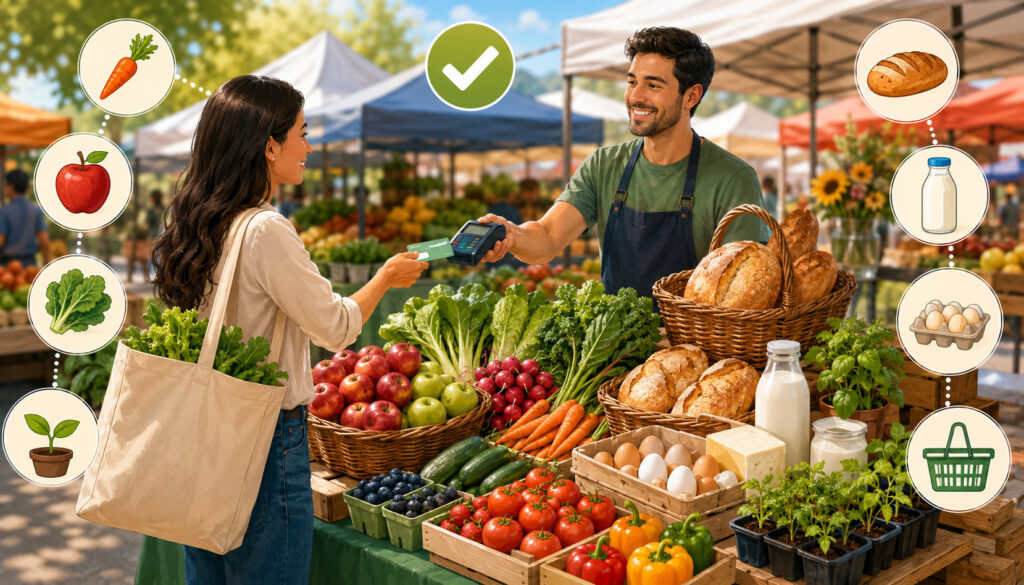
Many traditional farmers market products fit naturally within eligible food categories. However, each market should review products carefully rather than assuming every edible item qualifies.
Commonly eligible categories generally include:
- Fruits and vegetables
- Meat, poultry, and fish
- Dairy products
- Breads and cereals
- Eggs
- Snack foods
- Nonalcoholic beverages
- Seeds and plants intended to produce food for the household
Fresh produce is often the most visible category, but SNAP eligible foods can extend beyond fruits and vegetables. A qualifying transaction might include a loaf of bread, a dozen eggs, raw meat, cheese, dry beans, grains, or a plant that will grow edible vegetables.
Foods intended for home preparation are generally easier to classify than hot ready-to-eat meals. However, the market should review each product based on current guidance rather than relying only on whether it appears nutritious or locally produced.
A central market should give vendors a written reference list and a way to ask questions. The market manager should also review products that change seasonally, such as prepared holiday foods, seedlings, beverages, or gift packages.
Official guidance indicates that benefits may generally purchase household foods and seeds or plants that produce food, while excluding categories such as alcohol, tobacco, supplements, and foods hot at the point of sale.
Fresh Produce and Staple Food Items
Farmers markets are often strong environments for SNAP participation because many vendors specialize in staple foods. Fresh apples, berries, leafy greens, tomatoes, potatoes, squash, beans, herbs, and other produce can help households use benefits for seasonal ingredients.
Other market vendors may sell eggs, milk, cheese, yogurt, raw meat, poultry, fish, bread, flour, grains, and packaged foods. These products can expand the range of eligible purchases and make the market more useful for weekly grocery shopping.
Food-producing seeds and plants may also qualify when they are intended to grow food for household consumption. A tomato seedling may be treated differently from an ornamental flower or decorative plant.
Market managers should consider how eligible products are displayed. Clear price labels and item descriptions make it easier for staff to calculate the SNAP portion of a mixed purchase.
Vendors should avoid making eligibility claims based only on product origin. Local, organic, handmade, or farm-grown status does not independently determine whether an item qualifies.
Nutrition incentive programs may increase the purchasing power available for certain foods, especially fruits and vegetables. These incentives can have separate funding, issuance, redemption, and reporting rules, so they should not be treated as interchangeable with SNAP funds.
Non-Eligible Items to Separate Clearly
Common non-eligible categories generally include alcoholic beverages, tobacco products, vitamins, medicines, supplements, pet foods, household supplies, cosmetics, crafts, and foods sold hot at the point of sale. The official eligible-food guidance also explains additional exclusions and special cases.
A mixed-product farmers market must separate these items clearly. A booth might sell vegetables, cut flowers, handmade soap, and decorative baskets. Only the qualifying food products should be included in a SNAP transaction.
Supplements can be confusing because they may resemble food or beverages. Products carrying a Supplement Facts label are generally treated differently from products carrying a Nutrition Facts label. Staff should check current official guidance when classification is uncertain.
Gift baskets also require attention. A basket containing bread, jam, a candle, and decorative packaging should not simply be processed as one SNAP item. The eligible and non-eligible components may need to be separated, and some bundled arrangements may not be appropriate for benefit payment.
Hot prepared food is another frequent source of error. Markets should train food vendors not to assume that every edible product qualifies. Temperature and point-of-sale conditions may matter.
Market-Level vs Vendor-Level SNAP Application: Which Setup Fits?
Choosing the right application and transaction model is one of the most important planning decisions. The best option depends on market size, vendor mix, staffing, customer flow, technology, administrative capacity, and expected transaction volume.
| Application Setup | Best For | Benefits | What to Review |
| Market-level authorization | Multi-vendor farmers markets | Centralized EBT access and coordinated token tracking | Market management, staffing, vendor reimbursement, records |
| Individual vendor authorization | Eligible vendors selling directly | Direct control over transactions and reports | Vendor approval, equipment, eligible items, settlement |
| Token or scrip system | Markets with many qualifying vendors | Customers can shop across participating booths | Issuance, redemption, security, reconciliation |
| Direct EBT terminal | A single vendor or direct checkout | Simple booth-level collection | Equipment compatibility, connectivity, receipts |
| Mobile POS with EBT support | Portable or rotating operations | Flexible checkout and compact hardware | Verified EBT support, battery, wireless service, reporting |
| Hybrid setup | Markets with mixed vendor needs | Supports more than one operating workflow | Customer instructions, staff training, separate records |
A large community market may benefit from a central terminal because shoppers can access many vendors through one transaction. A small produce vendor attending several unrelated markets may prefer direct authorization and portable equipment.
Markets should not choose a setup only because the equipment appears inexpensive. The administrative cost of counting tokens, reimbursing vendors, resolving discrepancies, and staffing the EBT booth can be significant.
Similarly, direct vendor terminals can reduce central administration but may produce longer booth-level checkout times or inconsistent signs. Compare the full operating workload rather than only the application process.
How to Choose the Right Setup
Begin with the number of vendors that regularly sell eligible foods. A market with two produce sellers may not need the same central system as a market with dozens of farms, bakeries, meat producers, and food vendors.
Next, evaluate staffing. A central EBT station should be available throughout market hours, including opening, closing, and peak traffic periods. Staff must know how to process transactions, explain tokens, protect customer privacy, and close out the equipment.
Review customer flow. If the market is spread across several blocks, one central booth may be difficult to find. Multiple clearly marked access points may be more convenient, subject to approved equipment and operating arrangements.
Consider vendor reimbursement. Markets need enough cash flow or settlement timing flexibility to reimburse vendors according to the published schedule.
Technology also matters. Rural locations may have weak cellular service, while urban events may experience congested networks. Equipment should be evaluated under actual market conditions.
Finally, compare the reporting needs. The market should be able to determine how much was processed, how much market currency was issued, how much vendors redeemed, and whether outstanding tokens remain in circulation.
Why Setup Choice Affects Operations
The application structure determines who is responsible for the transaction. In a market-level model, the central organization generally controls the terminal, receives settlement, issues market currency, and reimburses participating sellers.
That means the market needs vendor agreements describing eligible products, token acceptance, redemption deadlines, reimbursement schedules, lost-token treatment, and reporting responsibilities.
With individual vendor authorization, the vendor generally handles the customer’s EBT card directly. The vendor manages equipment, user access, settlement, receipts, refunds, and transaction reconciliation.
The setup also affects the customer experience. A central token system may require the shopper to visit an information booth before shopping. Direct processing allows the customer to pay at the booth but may not be available at every eligible vendor.
Hybrid systems can create confusion unless signs clearly explain each method. Customers should not have to reveal unnecessary personal information or repeatedly ask whether a booth accepts benefits.
A written operating diagram can help. Identify who processes the card, who holds market currency, who verifies redemptions, who reimburses vendors, and who resolves a disputed total.
EBT Equipment and Payment Tools Needed After Approval
After authorization, the market or vendor needs compatible equipment and transaction services. A general-purpose card reader does not necessarily support EBT, even when it accepts debit cards.
Confirm EBT capability directly with the equipment or transaction-service provider. Ask whether the system supports SNAP purchases, balance inquiries where permitted, voids, refunds, receipt options, settlement reporting, user permissions, and the authorized retailer’s operating model.
Common tools may include:
- An EBT-capable countertop or mobile terminal
- A smartphone or tablet with an approved EBT application
- A secure card reader or integrated terminal
- Receipt printing or digital receipt capability
- A cellular data plan or approved network connection
- A charging station or battery pack
- A token or scrip inventory
- Vendor redemption forms
- Daily settlement and reconciliation reports
- Locked storage for equipment and market currency
A broader farmers market payment processing plan may also include debit, credit, and contactless payments. Keep those payment types separate in reports so SNAP activity can be reconciled accurately.
EBT Terminals and Mobile POS Systems
An EBT terminal for farmers markets should be portable, reliable, and simple enough for trained staff to operate during crowded market periods. Key considerations include battery life, screen visibility outdoors, keypad privacy, wireless connectivity, receipt options, and reporting.
A mobile POS for farmers markets may run on a smartphone or tablet, but ordinary mobile-card support is not enough. The provider must confirm that the proposed system can process SNAP for the applicant’s authorized setup.
Ask how staff sign in and whether permissions can be limited. A seasonal employee may need to process a purchase without accessing settlement settings or sensitive account information.
Receipt capabilities should also be reviewed. Customers may need a receipt showing the transaction amount and remaining information allowed by the system, while the market needs a daily transaction report.
Equipment should be protected from rain, heat, dust, and accidental drops. A weather-resistant case, shaded checkout area, and stable stand can reduce damage.
Before launch, conduct realistic practice sessions. Include successful transactions, canceled transactions, incorrect amounts, device restarts, receipt problems, and end-of-day report retrieval.
Connectivity and Backup Planning
EBT transactions generally require a reliable authorization connection. Markets should not assume that an offline mode designed for ordinary card payments will work for benefit transactions.
Test cellular coverage at the exact market location, at the same time of day the market operates. Network performance can change when large crowds gather or when several vendors use the same service.
A backup plan may include:
- A terminal with more than one approved connection method
- A secure mobile hotspot
- A charged backup device
- Spare cables and power banks
- Printed support instructions
- Provider and program contact numbers
- A written procedure for pausing EBT transactions during an outage
Markets should never invent a manual process or write down card details when the system is unavailable. Staff should follow only approved procedures.
Power planning is equally important. Charge devices before opening, disable unnecessary applications, carry tested battery packs, and assign someone to monitor remaining power.
Setting Up Tokens, Scrip, or Market Currency
A central scrip system allows one authorized market terminal to support purchases across multiple eligible vendors. The shopper uses an EBT card at the central station and receives market currency equal to the approved transaction amount.
Market currency may take the form of wooden or plastic tokens, paper scrip, or another permitted instrument. Each form should be unique enough to prevent confusion with ordinary cash, debit tokens, incentive tokens, or currency from another market.
The official description of scrip systems explains that one central POS device processes EBT transactions and the market’s own currency is used for shopping with participating sellers.
A strong token policy should explain:
- Who may issue tokens
- Permitted denominations
- Which vendors may accept them
- Which products qualify
- Whether change may be provided
- How returns are handled
- How vendors submit tokens
- How tokens are counted and verified
- When vendors receive reimbursement
- How damaged, lost, or suspicious tokens are handled
- How outstanding tokens are tracked
SNAP tokens should remain distinct from nutrition incentive currency. A shopper may receive both during one visit, but the two types may have different product restrictions and funding sources.
How Token Systems Support Multi-Vendor Markets
A token system can make a large market easier to navigate. Instead of requiring every farmer to maintain an EBT terminal, the market operates a central station and participating sellers accept a shared currency.
For example, a shopper may authorize a benefit transaction at the information booth and receive tokens. The shopper can then use those tokens for fresh produce at one booth, eggs at another, bread at a bakery stall, and qualifying meat from another seller.
Vendors treat approved market currency as payment for qualifying items. At the end of the market or another scheduled time, they submit the collected currency to the market manager.
The market verifies the amount, documents the vendor redemption, and reimburses the seller according to its written schedule. This customer-token-vendor-reimbursement flow should be explained during vendor training.
The system can also improve visibility. A clearly marked central booth gives shoppers one place to ask questions about SNAP EBT at farmers markets, incentive programs, vendor participation, and eligible products.
However, the booth should be placed in a convenient and respectful location. Customers should not be forced to stand in an isolated or unnecessarily visible line that identifies them as benefit users.
Tracking Tokens and Vendor Reimbursements
Token accounting should begin with a controlled inventory. Record how many tokens exist, their denominations, where they are stored, and who may access them.
During each market, staff should record:
- The beginning token inventory
- SNAP transactions processed
- Tokens issued
- Voids or corrections
- Tokens returned by customers where permitted
- Tokens redeemed by each vendor
- Tokens remaining at closing
- Tokens still expected to circulate
- Vendor reimbursement amounts
- Differences requiring investigation
The total value of tokens issued should be compared with approved EBT transactions. Vendor redemption totals and remaining token inventory should also be reviewed.
Not every issued token will return on the same day. Customers may save market currency for a future market if permitted. The accounting system should therefore distinguish outstanding tokens from missing tokens.
Vendor reimbursement forms should include the vendor’s name, date, token count by denomination, total value, verification signatures, and payment status. Settlement reports should be retained with the corresponding market-day records.
SNAP Signage and Customer Education After Approval
Clear signs help customers understand that SNAP is accepted, where to begin, which products may be purchased, and which vendors participate. Signs can also reduce repetitive questions during busy market hours.
A market-level signage plan may include:
- Entrance signs showing that benefits are accepted
- Directional signs to the EBT booth
- Operating hours for the central station
- A simple explanation of the token process
- Eligible-food reminders
- A participating-vendor map
- Information about nutrition incentives
- Privacy-respectful customer instructions
- Contact information for market assistance
Use consistent wording and symbols across the market. If vendors accept SNAP tokens but do not process EBT cards directly, the sign should make that distinction clear.
Avoid overly complicated rule lists at the entrance. Provide a brief explanation on large signs and a more detailed reference at the EBT station.
Signs should be readable in outdoor light and placed at accessible heights. Consider language access and visual accessibility based on the community served.
Market-Level Signage
Entrance signs should tell shoppers that the market accepts SNAP and direct them to the correct location. Place signs near common arrival points, parking areas, public transportation stops, and information booths when appropriate.
At the EBT station, display the transaction steps in a logical order. For example: present the card, choose an amount, complete the transaction, receive market currency, and spend it with participating vendors.
The market should explain which tokens represent SNAP funds and which represent other payment types or incentives. Color and shape differences can help, but written labels are still valuable.
A vendor map can reduce frustration. Use a clear marker to identify booths accepting market currency for eligible food purchases.
Market staff should review signs after the first few operating days. Watch where customers stop, what questions they ask, and whether they can locate the booth without assistance.
Vendor Booth Signage
Each participating booth should display a consistent sign showing that approved market currency is accepted for eligible products. The sign should not imply that every item at the booth qualifies.
Mixed-product vendors may use shelf labels or small item markers to distinguish eligible food from non-eligible merchandise. Staff should still verify the transaction rather than relying only on signs.
A booth that processes EBT cards directly should indicate that direct card transactions are available. A booth that accepts only central-market tokens should say so clearly.
Vendor signs should be placed where customers can see them before joining a checkout line. This reduces the chance that a shopper reaches the front and learns that the payment method is unavailable.
Signs should also avoid language that could embarrass or single out customers. Present SNAP as one of the market’s accepted payment options and train staff to answer questions respectfully.
Training Vendors and Staff Before Accepting SNAP
Training converts written procedures into consistent market operations. Every staff member who processes transactions or handles market currency should understand the basics before serving customers.
Training topics should include:
- Eligible and non-eligible food categories
- How to separate mixed purchases
- EBT terminal steps
- Token issuance and acceptance
- Customer privacy
- Receipts
- Transaction corrections
- Refund procedures
- Vendor redemption
- Reimbursement timing
- Equipment security
- Daily reconciliation
- Escalation contacts
Market managers should document attendance and provide written reference materials. Seasonal staff and replacement volunteers should receive the same training as the launch team.
Use practical scenarios rather than relying only on a presentation. Ask trainees to process a mock purchase containing both eligible and non-eligible items, count tokens, complete a vendor redemption form, and identify what to do during an equipment outage.
Training should be refreshed when vendors add new products, equipment changes, or program guidance is updated.
Training on Eligible and Non-Eligible Products
Vendors should understand that eligibility is based on program rules, not whether a product is healthy, local, organic, expensive, or made by the seller.
Use examples from the actual market. A training exercise might compare raw vegetables, a food-producing plant, decorative flowers, packaged bread, hot prepared food, a supplement beverage, soap, and a gift basket.
Mixed booths need special attention. Staff should be able to calculate the qualifying portion of a purchase and explain that the remaining balance can be paid with another accepted method.
When an employee is uncertain, the safest approach is to pause and ask the designated market contact rather than guess. Maintain a reference list and update it as questions arise.
Markets should also explain any local or state-specific rules currently affecting product eligibility. Because program policies can change, training materials should include a review date and the source used.
Training on Customer Service and Privacy
Customers should be treated with the same courtesy regardless of payment method. Staff should avoid announcing benefit balances, commenting on purchases, or discussing a customer’s transaction with unrelated people.
The PIN entry area should provide reasonable privacy. Employees should never ask a customer to disclose a PIN or enter it on the customer’s behalf.
If a transaction is declined, staff should use neutral language. A decline may result from a connection problem, incorrect entry, insufficient available benefits, equipment error, or another issue.
Direct the customer to an appropriate support option without making assumptions. Do not debate eligibility or personal circumstances in front of other shoppers.
Customer education should be respectful and brief. Explain where the EBT station is located, how tokens work, and which vendors participate without making the process feel burdensome.
Recordkeeping and Reconciliation Requirements
Organized records help markets verify that EBT activity, token issuance, vendor redemption, settlement, and reimbursement align. They also help identify errors early.
Useful records may include:
- Terminal transaction reports
- Settlement reports
- Token inventory logs
- Daily issuance records
- Vendor redemption sheets
- Vendor payment records
- Refund or correction notes
- Equipment incident logs
- Training records
- Current vendor lists
- Eligible-product guidance
- Copies of customer-facing instructions
- Approval and authorization communications
Records should be stored securely and retained according to applicable requirements and operational needs. Sensitive information should not be included in general spreadsheets unless necessary and appropriately protected.
Reconciliation should occur after every market rather than at the end of a long season. Small errors are easier to investigate while staff remember the day’s events.
Records Market Managers Should Keep
The market manager should be able to reconstruct the financial activity for each market day. Start with the EBT terminal report and total approved SNAP transactions.
Compare that amount with the value of SNAP market currency issued. Document voids, corrections, or other authorized adjustments separately.
Next, record the tokens redeemed by each vendor and the amount reimbursed. Retain evidence of vendor payment, whether reimbursement occurs by check, electronic transfer, or another documented method.
Track outstanding tokens rather than treating them automatically as a loss. Some customers may redeem market currency during a later visit.
Equipment problems should be documented with the date, time, device, issue, support contact, and resolution. This can reveal recurring connectivity or hardware problems.
Records Vendors Should Keep
Participating vendors should retain their own sales and redemption records. A vendor using direct EBT processing should compare terminal reports, settlement deposits, and qualifying sales.
A vendor participating in a central token system should record the tokens accepted each day and compare that total with the market’s redemption receipt.
Keep reimbursement records showing the amount submitted, amount approved, date paid, and any adjustment. Discrepancies should be reported promptly rather than carried forward informally.
Vendors should also retain current training materials and product guidance. When a new item is added, document whether it has been reviewed for eligibility.
Personal customer information should not be recorded unless specifically required through an approved process. Vendors generally need transaction totals, not unnecessary details about individual shoppers.
Common Application Mistakes to Avoid
One of the most common mistakes is applying before deciding who will operate the program. An application submitted by an individual vendor will not automatically authorize a market organization, and market-level authorization should not be treated as individual approval for unrelated vendor operations.
Other frequent problems include:
- Incomplete or inconsistent business information
- Incorrect ownership details
- Unclear market addresses
- Missing supporting documents
- Vague product descriptions
- Failure to separate eligible and non-eligible merchandise
- No central-token operating plan
- Purchasing incompatible equipment
- Weak vendor reimbursement procedures
- Lack of staff training
- Advertising acceptance before approval
- Inadequate recordkeeping
Another mistake is treating approval as the final step. A market can receive authorization and still struggle because equipment, signs, vendor agreements, customer instructions, or reconciliation procedures were not prepared.
Applicants should also avoid relying on old guides without checking the current official process. Forms, eligibility standards, equipment programs, and product rules may change.
Applying Without Choosing a Clear Market Structure
A market should decide whether SNAP will be managed centrally, directly by vendors, or through a structured hybrid before completing the application.
Without that decision, it becomes difficult to answer basic questions. Who owns the terminal? Who receives settlement funds? Who issues tokens? Who reimburses vendors? Who maintains records? Who handles refunds?
An unclear structure can also lead to inappropriate use of one authorization across unrelated businesses. Each participant should understand the limits of the approved arrangement.
Hold a planning meeting with market leadership and eligible vendors. Document the preferred model, responsibilities, costs, staffing, and customer flow.
The selected model should match the market’s actual capacity. A central system may be attractive, but it requires consistent staffing and financial administration.
Not Preparing for Operations After Approval
Authorization allows an eligible operation to participate, but the market still needs a functional launch plan.
Equipment must be ordered, configured, secured, charged, tested, and assigned to trained users. Vendor signs and customer instructions must be printed and installed.
A token market must create inventory controls, redemption forms, reimbursement schedules, and procedures for outstanding market currency.
The market should decide how to handle a device outage, an incorrect transaction amount, a customer refund request, a damaged token, or a vendor redemption discrepancy.
Support contacts should be available during every market. Staff should know whom to call for equipment issues and whom to contact for program-rule questions.
Best Practices for Applying for SNAP at Farmers Markets
Markets and vendors can improve readiness by following several practical habits:
- Review official SNAP retailer guidance before applying.
- Choose the applicant and operating structure early.
- List eligible and non-eligible products separately.
- Gather consistent legal and operating information.
- Prepare responsible-party details securely.
- Maintain an accurate participating-vendor list.
- Plan the EBT equipment and settlement arrangement.
- Confirm that mobile tools specifically support SNAP.
- Design the token or scrip process before launch.
- Create written vendor reimbursement procedures.
- Prepare customer and vendor signage.
- Train every person who will handle transactions.
- Test equipment at the market location.
- Reconcile activity after each market day.
- Protect customer privacy.
- Keep approval and transaction records organized.
- Review procedures regularly.
- Maintain current official support contacts.
A market should treat accepting SNAP at farmers markets as an ongoing operating program, not a one-time equipment installation. Reliable service depends on consistent procedures across every market day.
Creating a SNAP Launch Plan
A launch plan should identify tasks, owners, and completion dates. Begin with the application and documentation phase, then move through equipment, training, signs, market currency, reporting, and customer outreach.
Assign one person to lead authorization communications and another to review operations. In a small market, one person may hold both roles, but responsibilities should still be documented.
Create a pre-opening checklist covering device charging, connection testing, token inventory, cash or reimbursement controls, signs, vendor participation, and staff assignments.
Conduct a practice market before the public launch. Simulate several customers, mixed purchases, token redemptions, and a connectivity failure.
The launch plan should also include support contacts and an escalation path. Staff should know who can approve a correction, who can access settlement reports, and who should respond to a vendor discrepancy.
Reviewing Procedures After Approval
The first market days provide valuable operational information. Observe whether customers can find the EBT station, understand market currency, and identify participating vendors.
Ask vendors whether token rules are clear and whether reimbursement forms are practical. Review whether staff can retrieve daily reports without assistance.
Compare transactions, issued tokens, redemptions, and remaining inventory. Investigate differences while details are fresh.
Review customer questions and use them to improve signs. If many shoppers ask whether they can receive cash change, add a clear explanation to the booth instructions.
Schedule a formal review after the launch period and periodically thereafter. Update training when equipment, vendors, products, incentive programs, or official guidance changes.
SNAP Acceptance Application Checklist for Farmers Markets
The following checklist can help an applicant organize information before submission and prepare for operations after approval.
| Checklist Area | What to Prepare | Why It Matters |
| Applicant type | Market organization or individual vendor | Determines the authorization structure |
| Business details | Legal name, address, contact, responsible party | Supports accurate review |
| Product list | Eligible and non-eligible items | Helps confirm program fit |
| Market details | Location, schedule, participating vendors | Explains the operating model |
| EBT equipment | Terminal or POS plan | Prepares the transaction process |
| Token process | Issuance, acceptance, and redemption rules | Supports central multi-vendor operations |
| Signage plan | Customer directions and vendor identifiers | Reduces confusion |
| Training plan | Staff and vendor guidance | Prevents transaction errors |
| Recordkeeping | Logs, reports, settlement records | Supports accountability |
| Reconciliation | Market-day review procedure | Helps prevent payout differences |
This checklist does not replace the official application instructions. It is an organizational tool that helps applicants identify missing decisions and documents.
How to Use the Checklist Before Applying
Work through the checklist with the person responsible for the application and the person who will oversee market-day operations. These roles may see different problems.
Mark each item as complete, incomplete, or requiring official guidance. Do not treat assumptions as completed tasks.
For the applicant-type section, document why the chosen structure fits. For the product section, review actual vendor inventory rather than a generic list.
For equipment, obtain written confirmation that the proposed setup supports authorized SNAP EBT transactions. For tokens, create sample logs and reimbursement forms before ordering a large inventory.
Finally, conduct an application review against supporting documents. Check spelling, legal names, addresses, contact details, schedules, and responsible-party information.
Documents and Records to Keep After Approval
Keep the approval notice and authorization information in a secure, accessible file. Limit access to people who need the information for program administration.
Retain copies of submitted application materials, follow-up responses, equipment agreements, provider instructions, and account changes.
Operational records should include transaction reports, settlement reports, token logs, vendor reimbursement forms, training materials, current vendor agreements, signage files, refund notes, and equipment incident records.
Use a consistent naming system. For example, group records by market date and include the EBT report, token inventory, vendor redemption forms, and reimbursement evidence together.
Back up digital records and protect sensitive information with appropriate access controls.
How to Choose Farmers Market POS Systems for SNAP Acceptance
A farmers market POS system should be selected only after confirming that it supports the applicant’s authorized EBT model. A system designed for ordinary credit and debit cards may not process benefit transactions.
Evaluate the following:
- Confirmed SNAP EBT support
- Compatibility with the retailer authorization
- Mobile terminal options
- Cellular and Wi-Fi connectivity
- Battery performance
- Outdoor durability
- Receipt printing or digital receipts
- Balance and transaction functions permitted by the system
- Void and refund workflows
- Settlement reporting
- User permissions
- Multiple-location support
- Token or market-currency reporting
- Vendor reimbursement exports
- Transaction fees
- Equipment costs
- Training
- Technical support availability
- Replacement-device procedures
Markets processing several payment types should ensure reports separate SNAP, debit, credit, market currency, and nutrition incentive activity.
A flexible mobile payment setup for farmers market vendors can be useful for ordinary card transactions, but the applicant must independently verify SNAP compatibility.
Questions to Ask Before Choosing EBT Payment Tools
Ask potential providers:
- Does this system specifically support SNAP EBT?
- Will it work with our authorization and market structure?
- Can it be used at our approved locations?
- Does it support central-market transactions?
- How are settlement reports generated?
- Can reports be exported by date and location?
- How are voids and refunds handled?
- What receipt options are available?
- Does the device require continuous connectivity?
- Is any offline EBT procedure supported and officially permitted?
- What happens when the network fails?
- How long does the battery last?
- Can employee permissions be limited?
- How are lost or damaged devices replaced?
- What are the equipment, processing, wireless, and support costs?
- Is training included?
- Is support available during weekend market hours?
- How is sensitive payment information protected?
- Can the system support separate reporting for incentive programs?
Keep provider responses in writing where possible. Avoid relying only on a salesperson’s statement that a device is “EBT ready” without confirming activation, authorization, network, and reporting requirements.
Comparing Simplicity, Reliability, and Reporting
The least expensive terminal is not always the lowest-cost operating choice. An unreliable device can create long lines, missed transactions, staff frustration, and additional administrative work.
Simplicity matters because many farmers markets rely on seasonal staff or volunteers. The transaction steps should be easy to learn without weakening security or reporting controls.
Reliability includes more than the device. Evaluate the wireless connection, battery, software, settlement process, report availability, technical support, and replacement procedure.
Reporting can be especially important for a central market. The manager needs to compare EBT transactions with tokens issued, vendor redemptions, outstanding market currency, and reimbursements.
Choose a system that supports accurate reconciliation during real market conditions. A slightly higher equipment cost may be reasonable when the system reduces errors, improves customer flow, and produces usable reports.
Frequently Asked Questions
How do you apply for SNAP acceptance at farmers markets?
Begin by reviewing current official retailer eligibility and application guidance. Decide whether the farmers market organization or individual vendors should apply, then gather accurate business, ownership, product, location, schedule, and responsible-party information.
Complete the official retailer application, submit any requested supporting documentation, and respond promptly to follow-up communications. Do not begin accepting benefits until formal authorization and equipment activation are complete.
After approval, configure compatible EBT equipment, train staff, install signs, create recordkeeping procedures, and test the complete customer and reconciliation process.
Who can apply for SNAP authorization at a farmers market?
A qualifying farmers market organization may apply to operate a centralized system, while eligible farmers, direct marketing producers, farm stands, and food vendors may apply independently.
The correct applicant depends on who controls the retail operation and how transactions will be processed. Sellers offering qualifying foods may be eligible, but participation in a farmers market alone does not guarantee approval.
Applicants should review current official eligibility requirements and request guidance when their organizational structure is unusual.
Can individual vendors apply for SNAP EBT acceptance?
Yes, an eligible vendor may be able to submit an individual SNAP EBT application. Direct authorization can be useful for farmers and food producers that attend multiple markets or want to process transactions at their own booths.
The vendor is generally responsible for equipment, eligible-item controls, transaction reports, settlement, refunds, staff training, and recordkeeping.
Individual approval should not be confused with market-wide authorization. Other vendors cannot automatically process transactions under one seller’s approval.
What information is needed for a farmers market SNAP application?
Applicants may need legal and trade names, operating and mailing addresses, contact information, business structure, responsible-party details, market schedules, locations, product categories, and supporting documents.
A central market may also need information about participating vendors and the types of qualifying foods sold. Requirements can vary, so applicants should follow the current application instructions rather than relying exclusively on an older checklist.
What foods can be sold with SNAP at farmers markets?
Commonly eligible categories generally include fruits, vegetables, meat, poultry, fish, dairy products, eggs, bread, cereals, snack foods, nonalcoholic beverages, and seeds or plants that produce food.
Common exclusions generally include alcohol, tobacco, supplements, hot food at the point of sale, pet food, household goods, crafts, and decorative products. Markets should check current official eligible-food guidance, especially when a product is prepared, bundled, unusually labeled, or subject to local restrictions.
What equipment is needed after SNAP approval?
An authorized market or vendor generally needs an EBT-capable terminal or approved mobile system, transaction services, a reliable network connection, power or battery backup, receipt capability, and reporting access.
A central market may also need tokens or scrip, secure storage, vendor redemption forms, reimbursement tools, and reconciliation records. Confirm compatibility before purchasing equipment. Accepting ordinary debit cards does not automatically mean a device can process SNAP.
How do token systems work for farmers market SNAP acceptance?
The customer completes an EBT transaction at a central market station and receives approved market currency equal to the transaction value. The customer uses the currency with participating vendors for eligible foods.
Vendors return the collected currency to the market. The market verifies the amount and reimburses each vendor according to its written schedule. The market must track transactions, tokens issued, tokens redeemed, outstanding currency, vendor payments, and discrepancies.
What should markets do after getting approved for SNAP acceptance?
After approval, the market should activate compatible equipment, finalize vendor agreements, train staff, prepare signs, establish token controls, and test the full transaction process.
The market should also create daily reconciliation procedures, vendor reimbursement records, refund instructions, equipment outage procedures, and a secure document-retention system.
Procedures should be reviewed after the first several market days and whenever products, vendors, equipment, or official guidance changes.
Conclusion
Understanding how to apply for SNAP acceptance at farmers markets begins with choosing the correct applicant and operating structure. A multi-vendor market may apply for centralized authorization and operate a token or scrip program, while an eligible farmer or food vendor may apply to process EBT cards directly.
Preparation matters throughout the process. Applicants should review official guidance, identify SNAP eligible foods, separate non-eligible merchandise, gather accurate business and market information, submit complete documentation, and respond promptly to follow-up requests.
Approval is only the beginning of responsible SNAP acceptance. Markets and vendors still need reliable EBT equipment, secure payment handling, trained staff, clear customer signs, respectful service, organized transaction records, and tested backup procedures.
Central markets must pay particular attention to market currency. Tokens issued, tokens redeemed, settlement reports, vendor reimbursement, and outstanding balances should be reconciled consistently. Individually authorized vendors should compare qualifying sales with terminal reports and settlement deposits.
Because requirements and product rules may change, market managers and vendors should continue checking official program guidance and contacting the appropriate administrator when a situation is unclear.
With careful planning and consistent operating procedures, SNAP acceptance can help community markets provide more convenient access to fresh produce, staple foods, and other qualifying products while maintaining an accountable payment process.